
Hanging a picture looks like one of those jobs with no mystery to it, until you step back three paces and see it has ended up too high. The same goes for the TV that has you craning your neck for the whole film, the curtain rod that makes the window look lower than it is, or the shelf that starts sagging at the front after a couple of months.
Almost everything comes down to half a dozen measurements and knowing what is behind the wall. The first part is centimetres and takes ten minutes to learn. The second part is the fixing, and that is what decides whether the piece is still in place ten years from now or ends up on the floor one afternoon while someone is cleaning.
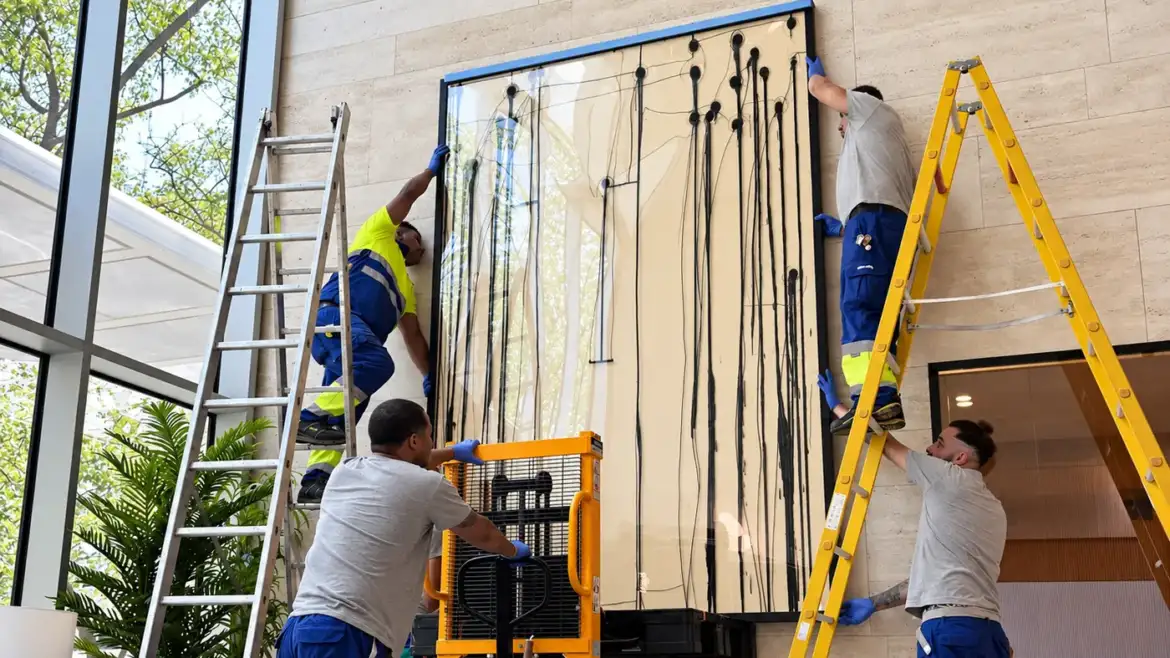
In our removals we see both sides of it. We go into homes where forty pictures have to come down, be numbered and go back up exactly as they were in the new flat, and we go into office lobbies to hang a two-metre piece with four people, a laser level and the floor protected. The measurements are the same in both places. What changes is the margin of error you can afford.
Below are the heights we use, the fixing that suits each type of wall and the order of work we follow on an installation. One note before we start: all measurements are taken from the finished floor, never from the ceiling or the skirting board.
Where the 145 cm height comes from
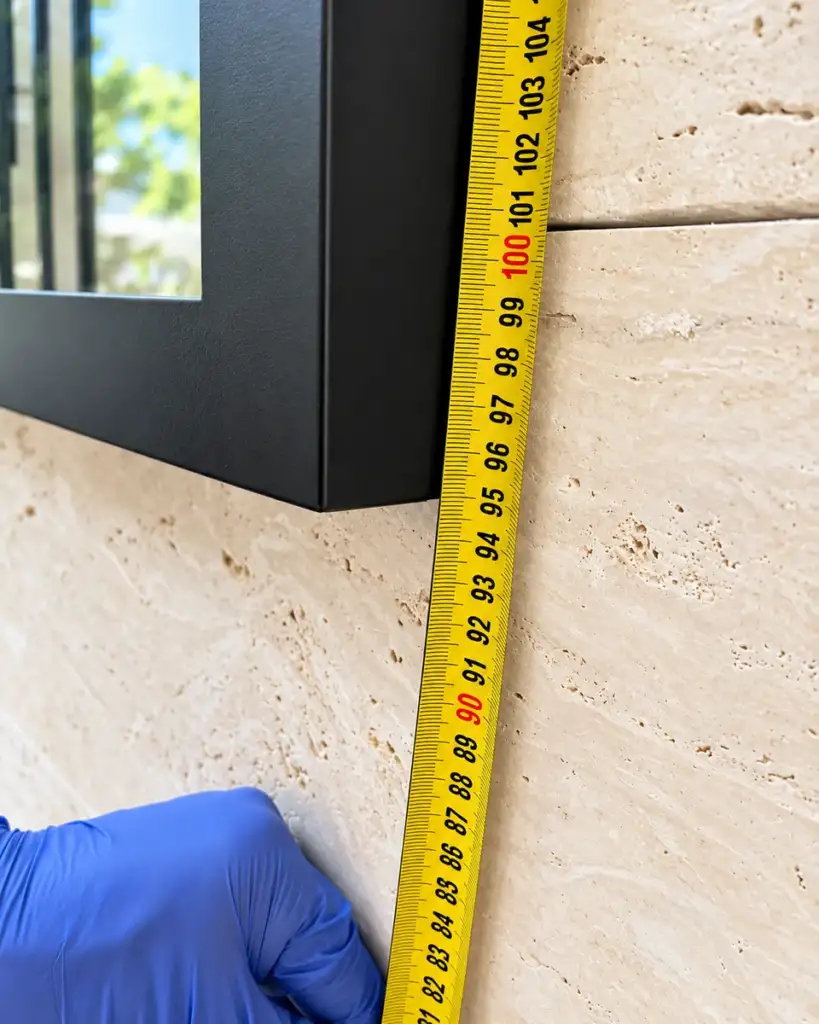
It is the height at which museums place the centre of their works. It comes from average height and the eye level of a standing person, which is around 150 cm. With the centre of the piece hung slightly below that, the work is comfortable to look at both standing and sitting.
The most common mistake at home is hanging too high. It happens because you lift the picture with your arms and leave it where it is easy to hold, which is about twenty centimetres above where it should go. If in doubt, go lower.
To work out where the nail goes when the picture hangs from a wire, there is a simple calculation:
- Measure the total height of the picture and divide it by two.
- Add 145.
- Pull the wire taut upwards and measure the distance from the top edge of the frame to the point where the hook will take the weight.
- Subtract that distance from the previous result. That is where the hook goes.
With a 70 cm tall picture whose wire pulls up to 6 cm below the frame: 35 + 145 = 180, minus 6, so the hook goes at 174 cm from the floor.
Height chart
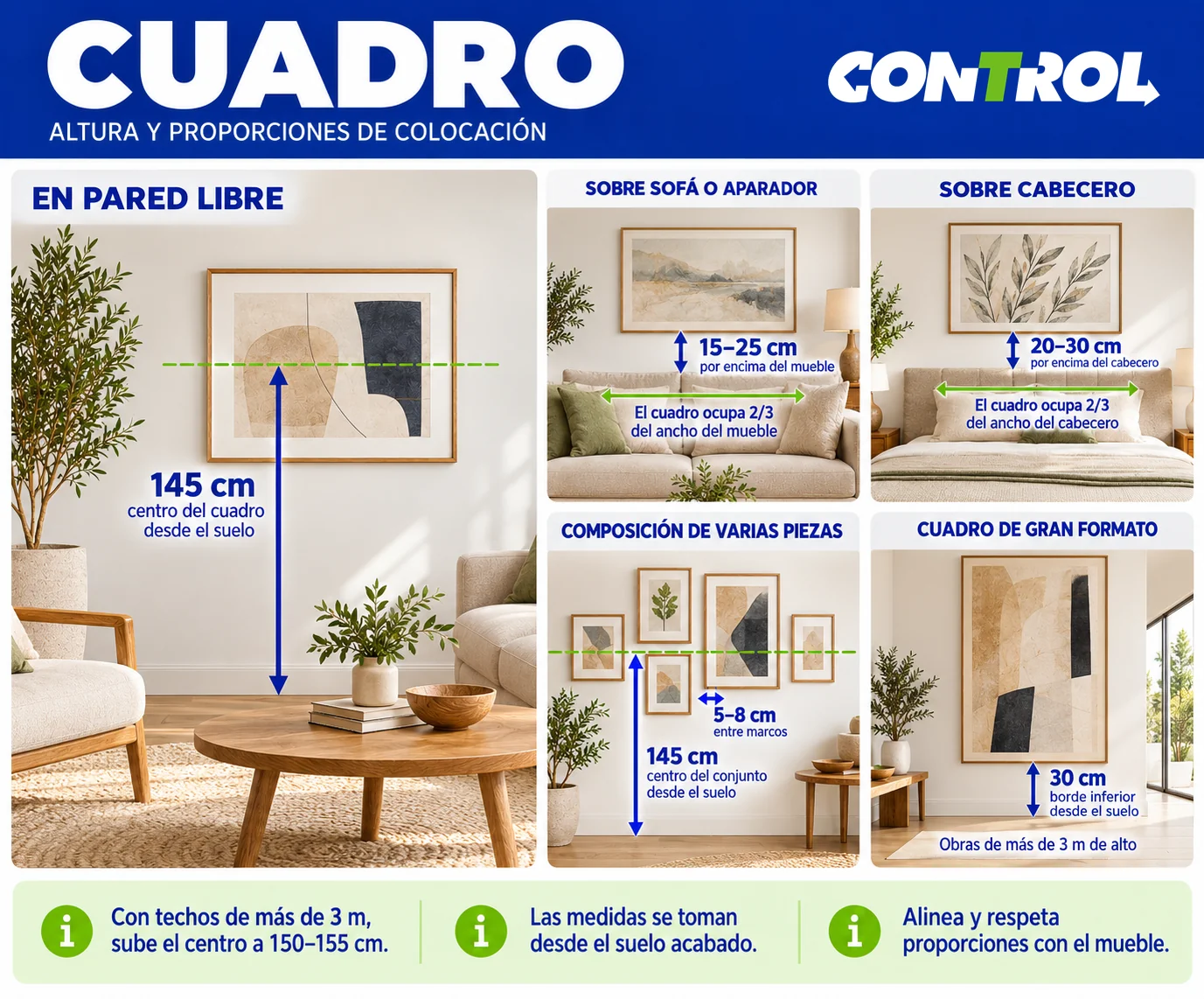
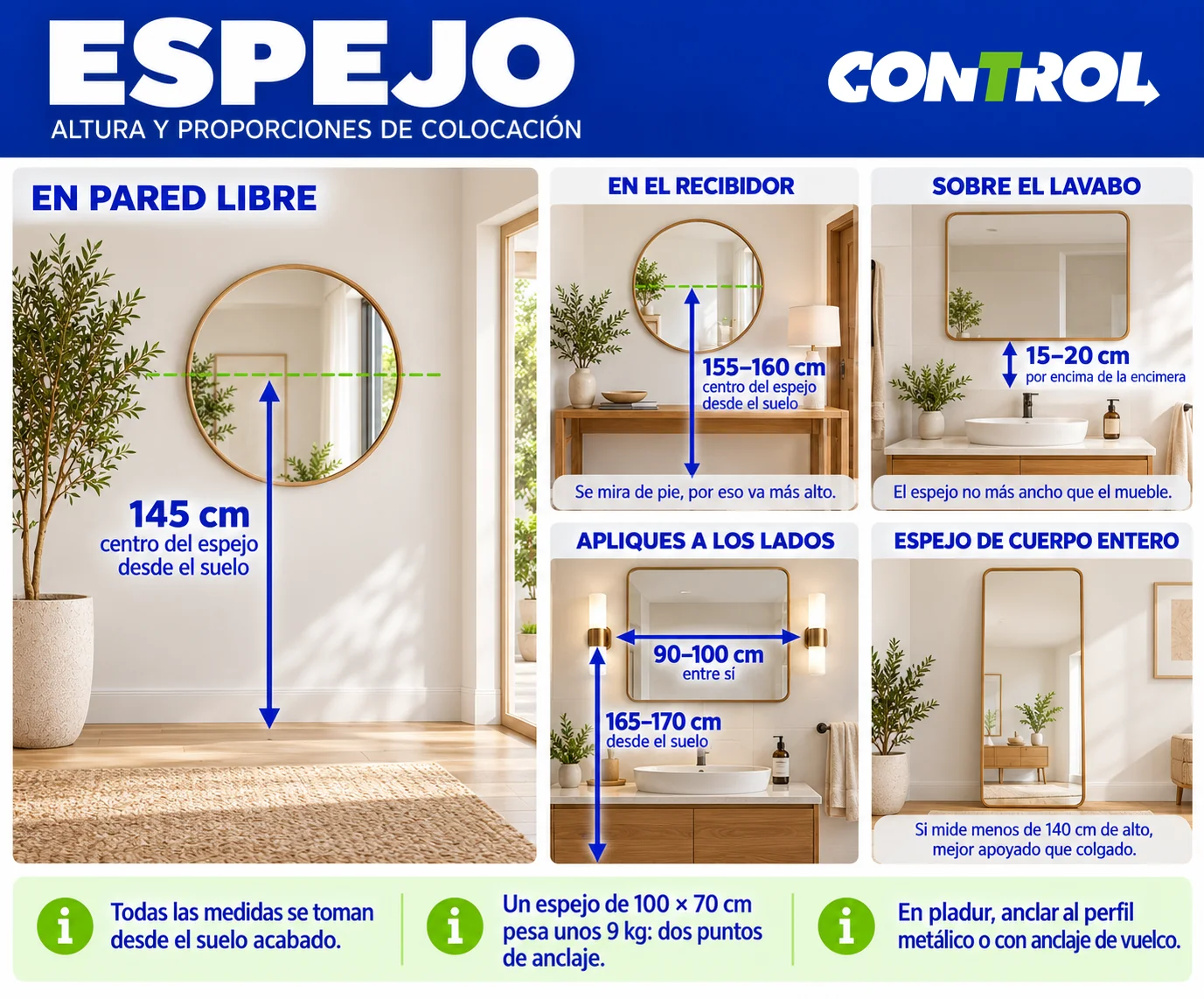
This is the cheat sheet. Each case is explained in detail below, and for pictures, mirrors, TVs and curtains there is a diagram with the measurements. Click on a diagram to open it full size.
| What you hang | Reference height | Keep in mind |
|---|---|---|
| Single picture or mirror on a bare wall | Centre of the piece at 145 cm | With ceilings over 3 m, go up to 150 or 155 cm |
| Picture above a sofa or sideboard | Bottom edge 15 to 25 cm above the furniture, 20 as a reference | The picture takes up two thirds of the width of the furniture |
| Picture above a headboard | Bottom edge 20 to 30 cm above it | Same two-thirds rule |
| Gallery wall | Centre of the group at 145 cm | 5 to 8 cm between frames |
| Work over 3 m tall | Bottom edge about 30 cm from the floor | At that size the centre rule no longer works |
| Hallway mirror | Centre between 155 and 160 cm | You look into it standing, so it goes higher |
| Mirror above a washbasin | Bottom edge 15 to 20 cm above the worktop | |
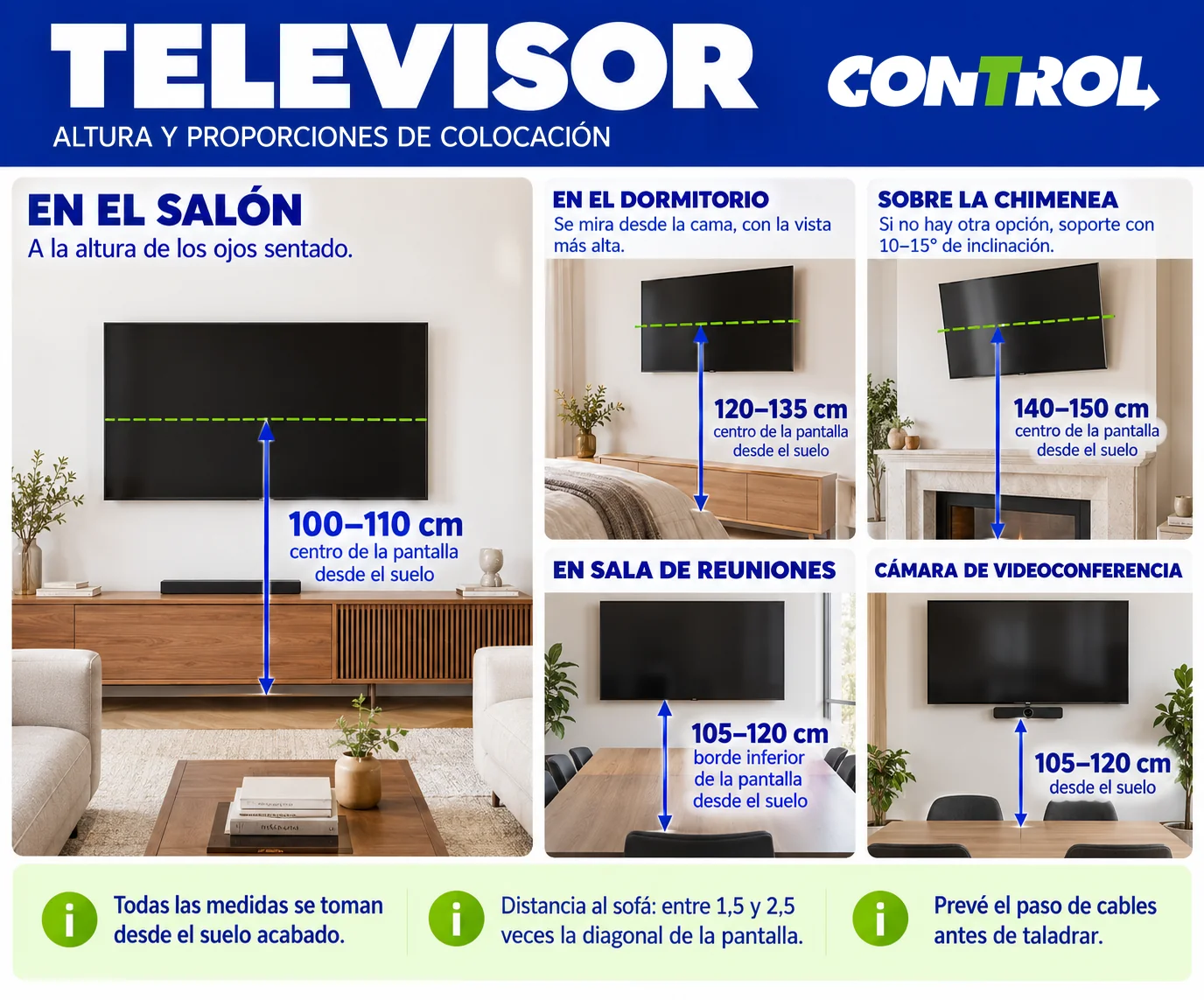
| TV in the living room | Centre of the screen between 100 and 110 cm | At eye level when seated |
| TV in the bedroom | Centre between 120 and 135 cm | Watched from the bed, with a higher line of sight |
| Screen in a meeting room | Bottom edge between 105 and 120 cm | So it can be seen over the heads of people sitting in front |
| Video conference camera | Between 105 and 120 cm | At the eye level of seated people, so it does not film from above |
| Room booking panel | Centre between 120 and 140 cm | If it must be accessible, between 80 and 120 cm |
| Curtain rod | 10 to 15 cm above the window frame | The rod extends 10 to 20 cm on each side |
| Roller or roman blind | Inside the recess, or 5 cm above the frame | |
| Shelf above a desk | 40 to 45 cm above the desktop | |
| Pendant light over a table or island | Bottom edge 75 to 85 cm above the top | You can see the face of the person opposite and it does not dazzle |
| Pendant in a walkway | At least 210 cm of clear space below | With ceilings over 2.60 m it can go higher |
| Wall light | Between 150 and 160 cm | |
| Wall clock | Between 180 and 200 cm | Above the line of sight |
| Wall coat rack | Between 165 and 170 cm |
Pictures
A single piece
Centre at 145 cm, and the rest is about width. A picture needs wall around it: if the wall is less than a metre and a half wide, a large piece overwhelms it. In narrow corridors several small pieces at the same height work better than one large one.
With large pieces the centre rule falls short and it is better to think about where the eye lands. One approach used by gallery owners and interior designers is to divide the work into three horizontal bands and place it so the eye falls on the top third. On a picture two metres tall, that puts the geometric centre well below 145 cm, and it still looks right.
Above three metres tall there is no point looking for a midpoint: the work goes with its bottom edge about 30 cm from the floor, and that is that.
One detail sets a well-hung wall apart: the piece is not centred vertically on the wall. Leave a little more space below than above. The eye reads as centred something that sits slightly above the true centre, and a work centred with a tape measure looks as if it has dropped.
And one decision you make once for the whole house: pick a centre height and stick to it in every room. Pictures at different heights in adjoining rooms look messier than crooked ones.
Not everything has to be hung. A work leaning on a sideboard, on a shelf or straight on the floor against the wall works well, can be moved without tools and is a sensible option while you decide. If the piece is heavy and is going to stay there, anchor the top to the wall so it cannot tip over.
Above furniture
Here the furniture rules, not the 145 cm guideline. The picture is seen together with the sofa or sideboard, so what has to work is the relationship between the two.
The width of the picture should be about two thirds of the width of the furniture. With a 210 cm sofa, a picture between 130 and 150 cm. The gap between the back of the sofa and the bottom edge of the picture, between 15 and 25 cm, with 20 as a reference. Less than 15 and it looks as if it is resting on it; more than 30 and the two stop reading as a pair.
Above a chest of drawers or a console table the gap drops to 15 or 20 cm, because the furniture is lower and the distance is more noticeable.
Gallery walls
The trick is to treat the group as if it were a single picture. Draw the rectangle taken up by all the pieces together, and that rectangle gets its centre at 145 cm.
The space between frames is 5 to 8 cm. With large pieces you can go up to 10, but beyond that the group falls apart and you see separate pictures instead of a composition.
Two tips that save holes. First, lay out the composition on the floor before touching the wall and move it around there until you are happy. Second, cut out the outline of each frame in brown paper, stick it up with masking tape and look at it for a while from the doorway. Paper moves in two seconds; a wall plug in the wrong place does not.
If the pieces are different sizes, aligning them on the horizontal centre line of the row gives a calmer result than aligning the tops or bottoms. In a grid of identical pieces it is the other way round: everything is aligned and the gap between frames must be the same vertically and horizontally.
So much for measurements. Deciding what to hang and what to pair it with is another matter, and it is worth reading people who do it for a living: in AD, architects Teresa Sapey and Jean Porsche explain how to display art at home (in Spanish) and why what matters is not the perfect size but the balance of the whole.
Mirrors
You do not hang a mirror to look at it, you hang it to look at yourself, so the height is set by the face and not by the centre of the piece.
In a hallway, the centre goes between 155 and 160 cm. In a dressing room, what matters is that the tallest person in the house can see their whole body: if the mirror is less than 140 cm tall, it is better to stand it on the floor and anchor the top to the wall than to hang it.
Above a washbasin, the bottom edge sits 15 to 20 cm above the worktop, and the mirror should not be wider than the vanity unit. If there are wall lights on either side, they go at 165 or 170 cm, where they light the face without dazzling.
A mirror weighs a lot more than it looks. A 100 by 70 cm mirror with 5 mm glass weighs about 9 kg, and with a solid wood frame it goes up to 15. That already calls for two fixing points and, on plasterboard, the metal stud or a toggle anchor.
TVs and screens
At home
The height of a TV is decided by your neck, not by looks. The centre of the screen should be at the eye level of whoever is watching it seated, which on a normal sofa is between 100 and 110 cm from the floor.
That clashes with the habit of putting it above the fireplace. A TV above a fireplace usually ends up with its centre at 140 or 150 cm, and has you looking up for two hours. If there is no alternative, at least use a mount that tilts 10 or 15 degrees.
In the bedroom it goes higher, because you watch half sitting up in bed: centre between 120 and 135 cm.
Distance matters too. For a 4K screen, the sofa goes at between one and a half and two and a half times the diagonal. With a 65-inch TV, which is 165 cm on the diagonal, that means between 2.5 and 4 metres.
In a meeting room
Here the rule changes: what matters is not eye level but making sure the bottom of the screen is not blocked by the head of the person sitting in front. The bottom edge goes between 105 and 120 cm, which puts the centre at around 150 cm on a 65-inch screen.
Two things that get forgotten when fitting out rooms. First, plan where the cables will come out before drilling, because running the HDMI afterwards means chasing the wall or leaving trunking on show. Second, check who sits at the far end: on a long table, the person furthest away has to read the text of a presentation, and that limits screen size more than the budget does.
The mount is chosen by the screen’s VESA standard, which is on the manufacturer’s spec sheet and refers to the four holes on the back. The screws in the mount’s box are for fixing the mount to the screen; to fix the mount to the wall you need to choose the anchor for whatever is behind it.
The video conference camera deserves a decision of its own. It goes at the eye level of seated people, between 105 and 120 cm, just below the screen or on the table, depending on the model. Mounted at the very top it films everyone from the ceiling, and the people on the other end of the call see a room full of the tops of heads.
The booking panel outside the room is read standing up and touched, so its centre sits between 120 and 140 cm. If the building must be accessible, the range drops to between 80 and 120 cm, which is the height Spain’s Building Code (CTE) sets for controls in its Annex A.
In an office relocation these measurements are decided before moving in, with the plan of the new floor on the table, not on moving day.
Curtains and blinds
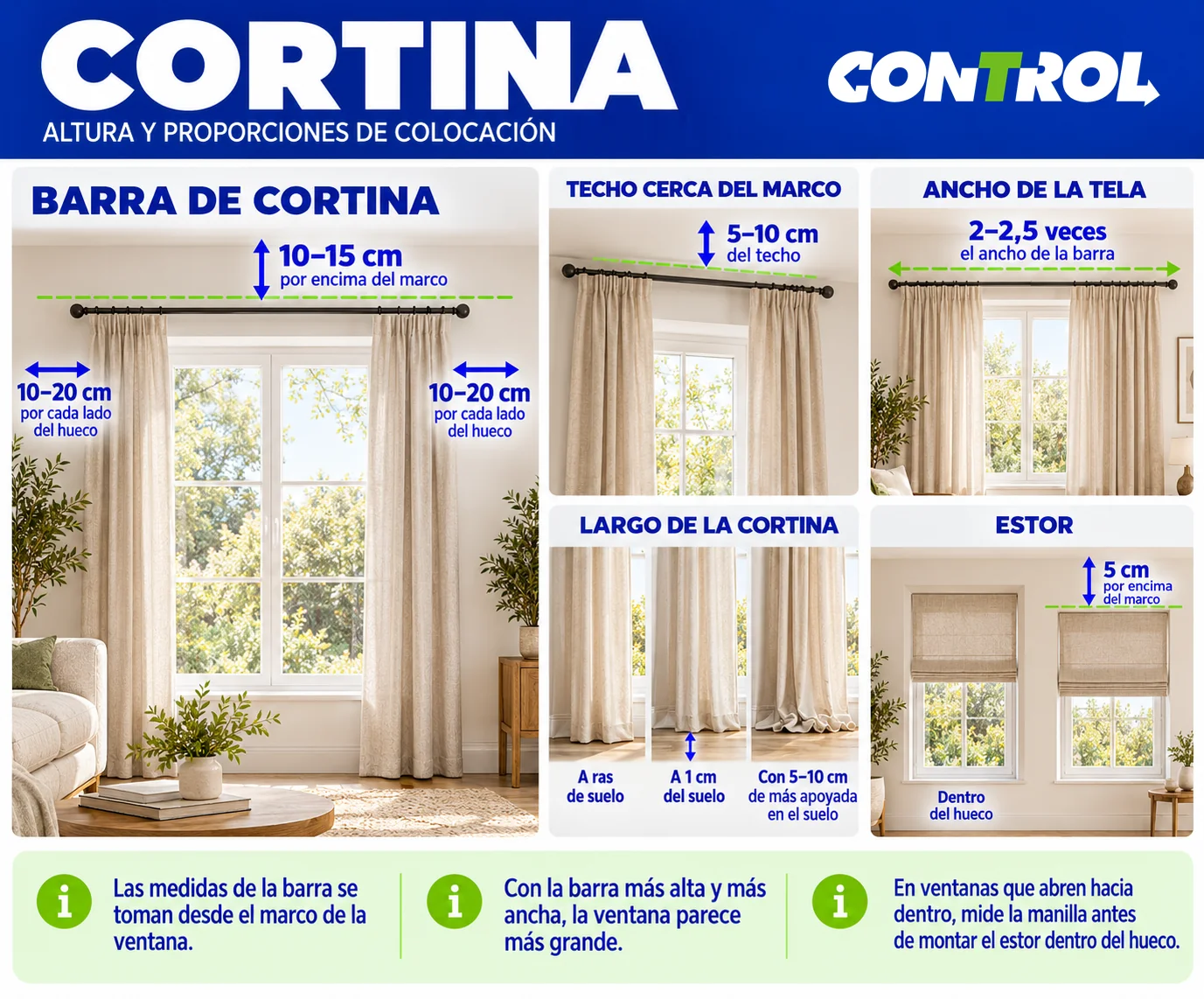
Curtains change a room more than anything else for very little money, and they are almost always hung badly for two reasons: the rod is too low and too short.
The rod goes 10 to 15 cm above the window frame. If the ceiling is less than 30 cm above the frame, it is better to take it straight up to 5 or 10 cm below the ceiling: the window looks taller and so does the room.
The rod extends past the recess on each side. The usual minimum is 8 or 10 cm, but with that the drawn-back curtain still covers part of the glass. If there is wall to spare, 15 or 20 cm on each side: the open curtain sits on the wall and all the light comes in.
The fabric has to be wider than the opening so it falls in folds. Two to two and a half times the width of the rod is normal; with less than two the curtain looks stretched and you can tell fabric is missing.
For length there are three options that work: just touching the floor, one centimetre above it, which is the most practical if you open and close it every day, or five to ten centimetres longer so it pools on the floor. What does not work is stopping halfway down the calf.
Blinds go inside the recess if the window has a deep enough reveal, or five centimetres above the frame if they are fitted outside it. On windows that open inwards, measure how far the handle sticks out before deciding, because a blind fitted inside the recess can stop the window from closing.
Shelves, wall lights, clocks and coat racks
A shelf above a desk goes 40 to 45 cm above the desktop. Any lower and a monitor will not fit underneath; any higher and you have to stand up to reach it. On a bare wall, the first shelf goes at the same height as a picture, with its centre around 145 cm, and the rest every 30 or 35 cm above or below.
What fails with shelves is not the height but the overhang. A 25 cm deep shelf on hidden brackets holds books; a 40 cm one on the same brackets sags at the front. If it is deeper than 30 cm, use visible brackets or angle brackets. Fitting shelves and furniture has its own knack, and we cover it in our post on disassembling and assembling furniture.
Wall lights go between 150 and 160 cm in a corridor or living room. Either side of a bathroom mirror they go up to 165 or 170, at face height. On a headboard they come down to 110 or 120 cm from the floor, where they light a book without shining in the face of the person sleeping next to you.
Pendant lights have their own measurement. Over a dining table or kitchen island, the bottom of the shade sits 75 to 85 cm above the top: low enough to light the table and high enough to see the face of the person opposite. In a walkway, heads come first: at least 210 cm of clear space underneath.
With table lamps the rule is the opposite of what people usually do. In a living room, the bottom of the shade should be at the eye level of someone seated or a little above, so nobody sees the bulb and the shade does not block the face of the person opposite. On a bedside table, at chin height when sitting up in bed. And if the room has different lamps, what ties them together is that all the shades end at the same height.
Two wall lights either side of a bathroom mirror go 90 to 100 cm apart. In a long row of wall lights along a corridor, 2.5 to 3 metres between each one.
The wall clock is one of the few things that goes above the line of sight: between 180 and 200 cm. A wall coat rack, between 165 and 170 cm, so a long coat can hang without touching the floor. If children use it, add a second row at 110 or 120.
Which fixing for each type of wall
A wrong height is fixed with one more hole. A wrong fixing is not: when it gives way, it takes the piece and a chunk of wall with it.
First, find out what is behind. Knock with your knuckles: if it sounds solid and dull, it is solid brick or concrete; if it sounds hollow, it may be hollow brick or plasterboard. To tell them apart, drill a millimetre with a thin bit and look at the dust. Reddish dust means brick; fine white dust means plasterboard.
| Wall | What to use | Approximate load per point |
|---|---|---|
| Solid brick or concrete | 6 or 8 mm nylon wall plug, hammer drill bit | 25 to 40 kg |
| Hollow brick | Cavity plug or metal toggle anchor | 10 to 25 kg |
| Plasterboard, into the cavity | Self-drilling metal plug | 8 to 15 kg |
| Plasterboard, medium load | Metal spring toggle anchor | 20 to 30 kg |
| Plasterboard, screwed to the stud | Screw straight into the metal stud | 40 kg or more |
On plasterboard, the right answer is almost always the last one: find the metal stud with a detector and screw into it. Studs are every 40 or 60 cm. A large TV or a loaded shelf should not hang from the board, it should hang from the structure.
A standard nylon plug is no good in plasterboard or hollow brick. It spins in the cavity, has nothing to expand against and holds only until someone brushes against the piece.
Three rules we always follow. From 10 kg up, two fixing points, even if the picture comes with a single hanger. Each fixing is rated for three times the weight it will carry, because nobody hangs a picture and leaves it alone: it gets dusted, straightened, has a ladder leaned next to it. And on wide pieces, two separate points stop it going crooked every time someone walks past.
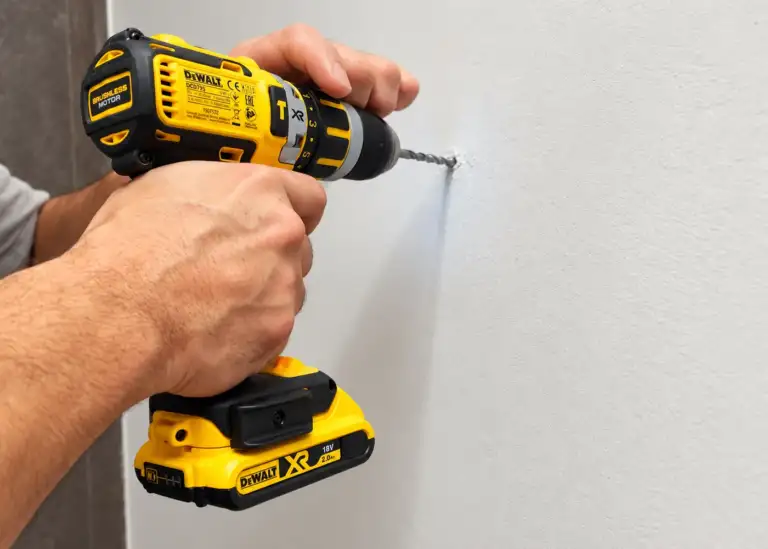
A note on the drill: hammer mode for brick and concrete, normal rotation without hammer for plasterboard, tiles and porcelain. On tiles, start with a tile bit and a piece of masking tape over the spot so the bit does not slip; once through the glaze, carry on with the bit for the material underneath.
If you want to go further into fixings, there are guides to fixings by material (in Spanish) that go plug by plug through which one suits each wall.
Before you drill
Walls have cables and pipes running through them, and not where you would expect. Spain’s low-voltage regulations set out where embedded electrical conduits may run, and that gives the areas to avoid:
- Vertically and horizontally from any socket, switch or light point, a strip of about 20 cm on each side of the line.
- Strips of 15 to 20 cm next to the ceiling, the floor and the corners.
- In kitchens and bathrooms, around and above water points.
These are likely areas, not guarantees. In older buildings, and in renovations done without plans, cables go wherever the electrician decided that day. A metal and cable detector costs little and pays for itself after one scare.
Three more checks before you pull the trigger. Look at the other side of the wall: if it is a thin partition, a long drill bit can come out in the bedroom next door. Check the thickness of the tiling before choosing the screw, because in a bathroom the tile and adhesive easily add up to a centimetre. And cover the spot with a damp cloth or tape a paper envelope under it to catch the dust and save half an hour of cleaning.
How we do it
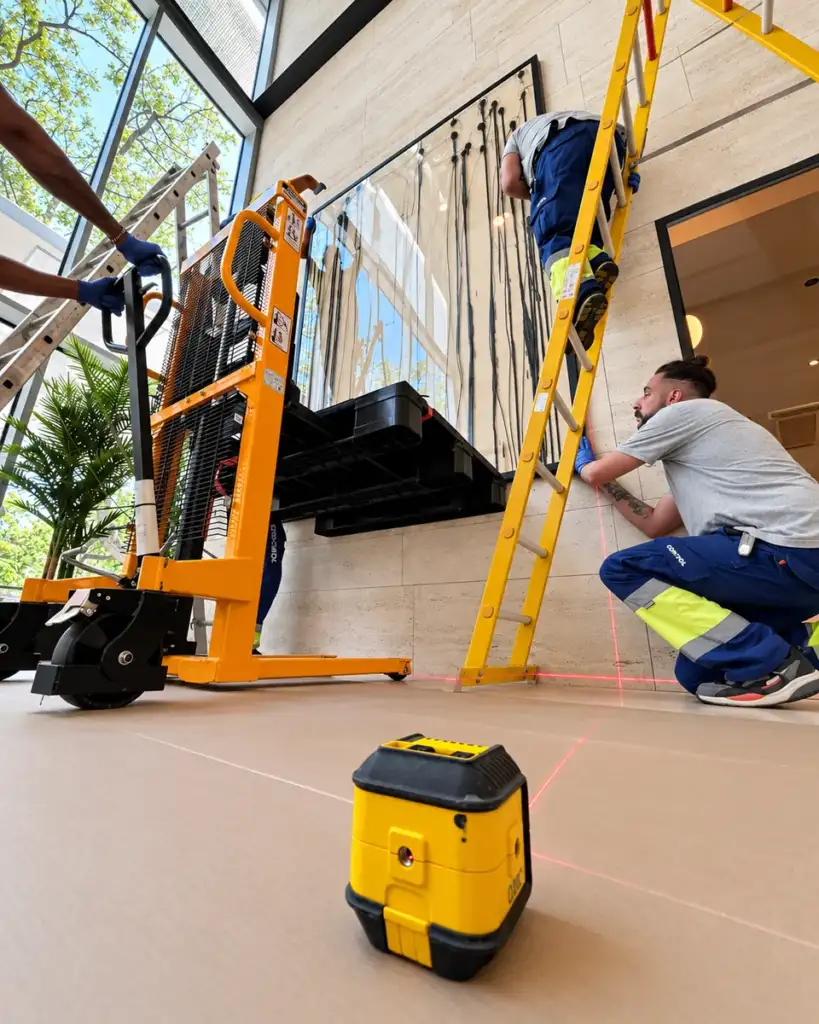
In a home you can work with a tape measure and a spirit level. In an office lobby with a two-metre piece you cannot, because any deviation can be seen from the street. This is the order we follow:
- Protect. Cardboard or blankets on the floor under the whole work area, and nearby furniture covered.
- Measure from the floor, not the wall. A cross-line laser level on the floor gives the true horizontal of the room. Floors slope and so do ceilings, so taking the reference from the ceiling ends with a picture that looks crooked even when it is level.
- Mark the axis. Project the horizontal line at working height and the vertical through the centre of the piece, and mark them with masking tape, never with pencil straight on the wall.
- Find any services with the detector and check the type of wall.
- Drill with the dust collected and fit the anchors.
- Hang with at least two people. A two-metre piece takes three or four, wearing nitrile gloves and holding it by the frame, never by the hanger or the canvas.
- Check and finish. Measure again from the floor at both ends, verify with the laser and clear everything away.
Artworks and valuable pieces
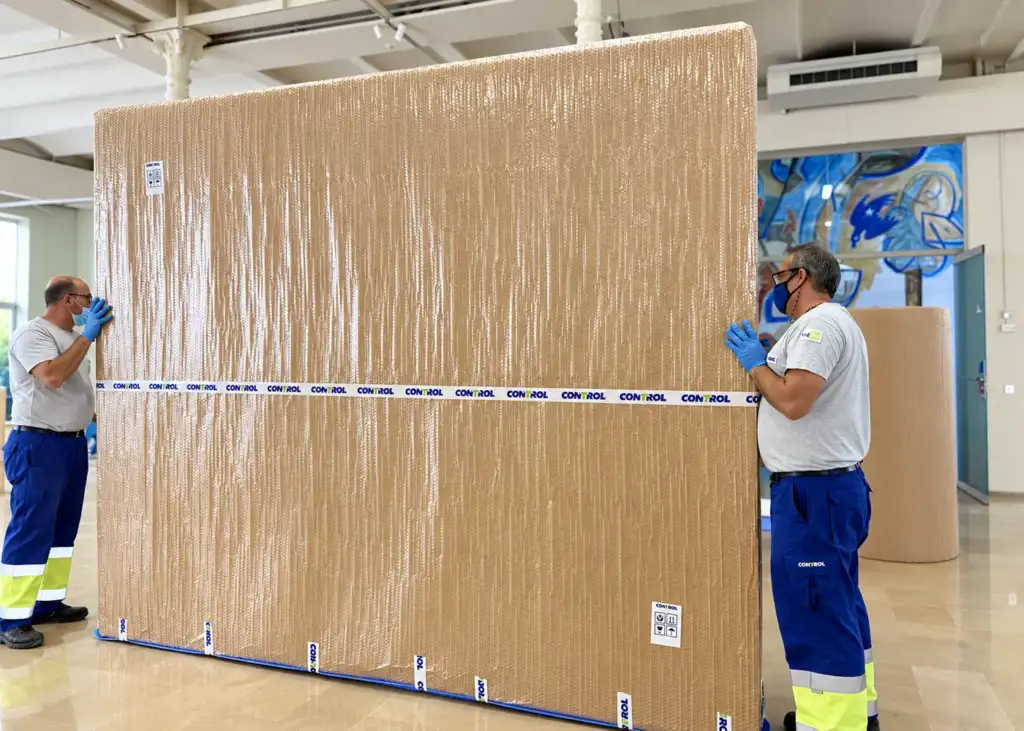
With an artwork the rules change, and the first one is that it does not hang from a picture hook.
The norm in museums and collections is a wall or ceiling rail with a rod and adjustable hook. You drill once, when fitting the rail, and from then on the work goes up, down and moves without touching the wall again. In a room that changes exhibitions every few months, that saves dozens of holes and touch-ups.
When the work is fixed directly to the wall, security hangers are used at two points, with a locking screw so it cannot be lifted off. For pieces over 30 or 40 kg the fixing is calculated separately and, if the wall is not reliable, it is anchored to the structure.
Other things we check before deciding where it goes:
- Distance from the wall. A few millimetres of clearance with spacers lets air circulate behind and prevents condensation on the back of the stretcher.
- The wall. No damp exterior walls, nothing above a radiator or a fireplace in use. Swings in temperature and humidity do more harm than a knock.
- The light. Never direct sunlight. Artificial light works better at an angle, around 30 degrees from the vertical of the work, than head on.
- Traffic. If the piece is in a walkway with trolleys or suitcases, raise it a few centimetres or protect the bottom corner.
- The insurance policy. Many fine art policies require the installation to be done by a company with liability insurance and to be documented. Read it before, not after.
With a large piece, getting it to the wall matters as much as hanging it. We move it packed to the foot of the wall, unpack it there and lift it with a stacker or slings, never by hand above our heads. That is the part we explain in artwork transport and picture transport.
Mistakes we see often
Hanging too high. By far the most common and the easiest to avoid: if you are torn between two heights, pick the lower one.
Measuring from the ceiling. Ceilings are not level and every room has its own height. All measurements, from the floor.
Using the plugs that came in the box. The fixings supplied with a TV or a bookcase are designed for a generic wall, and every wall is different.
Hanging a heavy piece from a single point. Even if the manufacturer fits one central hanger, from 10 kg up you need two.
Drilling without checking what is behind. A cut cable in a freshly painted wall costs more than the detector.
Ignoring the real weight. A framed mirror, a 75-inch TV with its mount or a bookcase full of books weigh far more than they look.
Leaving the picture leaning on the floor against the wall while you work. It is the position in which most pieces get broken, because all it takes is someone walking past and catching it with their foot.
When it is worth calling a professional
A two-kilo picture on a brick wall can be hung by anyone with a tape measure and some patience. There are four cases where doing it yourself does not pay.
Heavy or large pieces: a full-length mirror, a 75-inch TV, an artwork that does not fit through the living room door.
Walls that are not what they seem: plasterboard without knowing where the studs are, 1960s hollow brick partitions, stone or reinforced concrete walls.
Artworks and insured pieces, where the hanging system and the paperwork are part of the policy.
Installations in bulk: a whole office with signage, screens in several rooms and pictures in the offices. The hard part there is not hanging one piece, it is getting all forty at the same height.
In our home removals and business moves, installation and hanging are an optional service: they can be included in the quote together with the move, and the same team that moved the furniture does the job. If you would like us to price it, ask us for a quote and we will look at it during the site visit.
If you would rather we did it
In these four services, installation and hanging are part of the job plan from the site visit onwards. Before we arrive we already know which pieces have to be hung, on what type of wall, with which fixing and at what height. The team leaves the warehouse with what it needs to get it right first time: laser level, cable detector, plugs for each type of wall, security hangers and floor protection.
So there is no making do with whatever is left in the van, and no picture left leaning on the floor “for tomorrow”. Each piece is taken down, numbered, travels packed and goes back on the wall in the new home or office. It is hung by the same people who moved it, because we do not subcontract staff.
If you have something to hang, install or move and would rather leave it to professionals, you can count on us. These are the services where we do it every day:
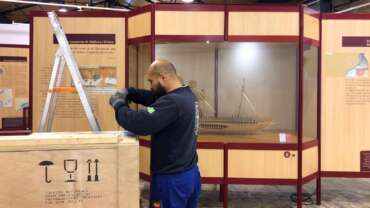
For museums, galleries and collections. Rail systems or security hangers, with every step documented for the insurance policy.
From one picture to a whole collection: custom packing for each piece and hanging on the new wall, at the right height.
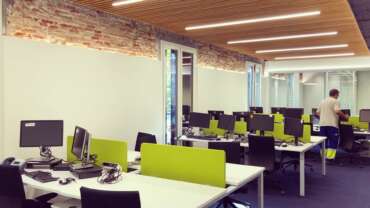
Office and business relocation
Meeting room screens, signage and office pictures. Forty pieces, all at the same height.
We take down, number and rehang pictures, mirrors and the TV. On your first day in the new home, everything is already on the wall.