
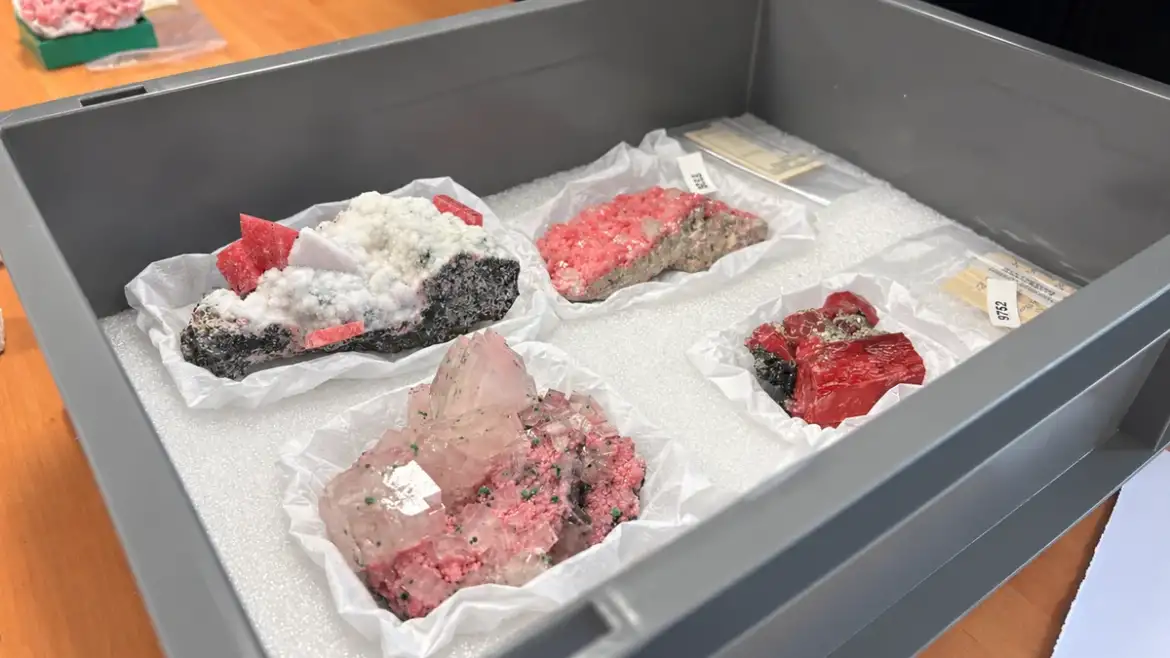
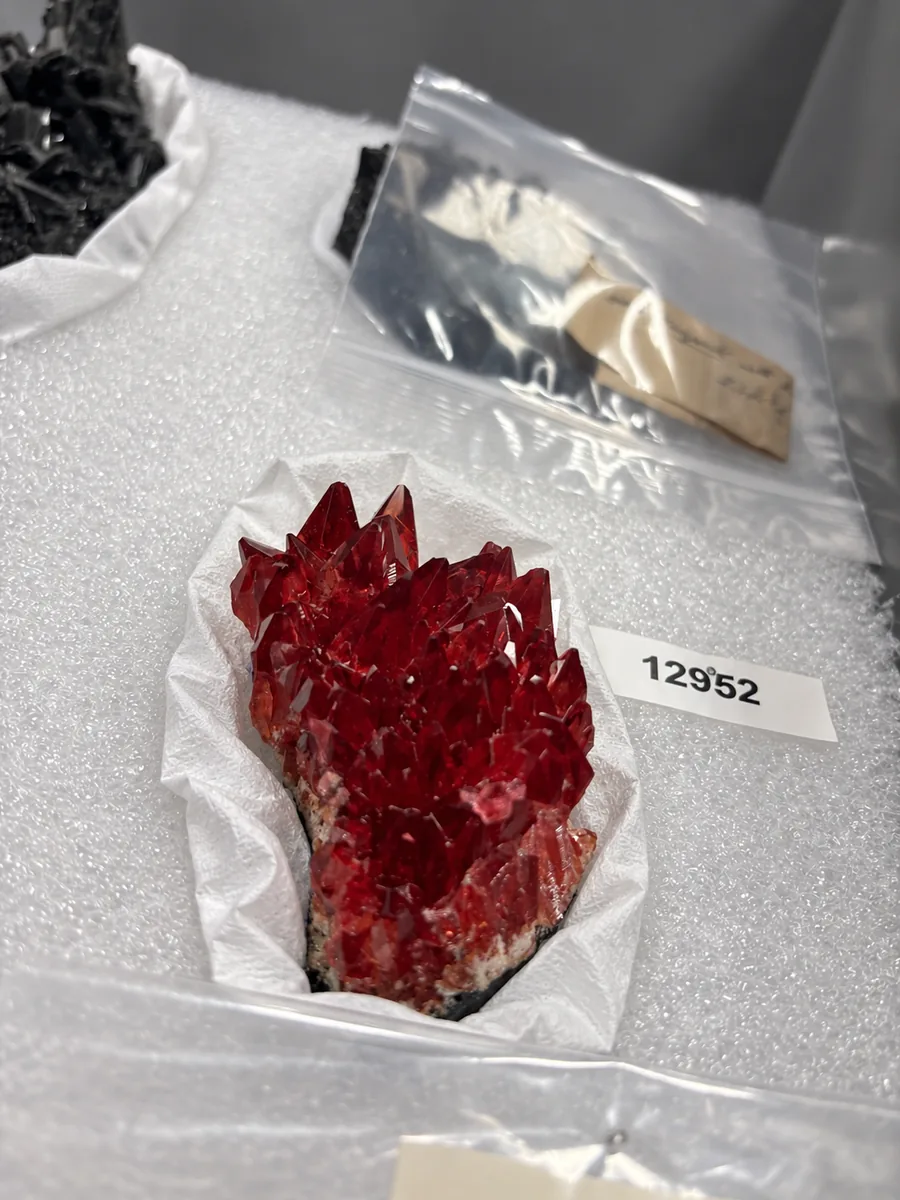
A group of red crystals rests on a sheet of foam, inside a nest of white tissue paper. Next to it, in a clear bag, is the handwritten label that goes with it. Each specimen has its own nest, its own number and its own box, and the grey boxes are stacked on a plastic pallet.
We are Control, and we worked for the Department of Culture of the Generalitat de Catalunya, which commissioned us to inventory, pack and transfer the Folch-Girona mineralogy collection to the reserves of the Museu de Ciències Naturals de Barcelona. In this article we explain what this collection is and how we moved it, with the challenge it involved: about 12,000 specimens, some of them needing radiation protection.
The Museu will publish, together with the Generalitat de Catalunya, a book about the collection. Here we describe our part of the work.
Joaquim Folch and his collection
Joaquim Folch i Girona (Barcelona, 1892-1984) was an engineer and businessman. He promoted lead mining and metallurgy in Catalonia, with the Bellmunt del Priorat mines, and was manager of Industrias Titán, a paint factory. Around 1908 he began collecting minerals. He gathered them himself, but he also swapped and bought them, and he carried on until he died. His descendants kept the collection and expanded it.
The collection officially consists of about 12,000 specimens. In 1984 it held 868 mineral species, 26% of the 3,300 known at the time. There are species from Catalonia, the Iberian Peninsula and all over the world, and many of the sites they came from no longer exist, so some specimens could not be obtained again.
Each specimen also has its own documentary archive: handwritten labels and cards describing the geology of the place where it was found. This is unusual among collectors, and the Catalan Government took it into account when it declared the collection a Cultural Asset of National Interest (Bé Cultural d’Interès Nacional) on 30 November 2021: the specimens cannot be separated from the archive that goes with them. This protection came after a sale to a foreign dealer was set in motion in 2019. The Department of Culture halted the export file and protected the collection as a whole.
A private collection that becomes public
The Generalitat de Catalunya has acquired the collection. Until then it was a private collection, closed to the public. Now the whole set, with its archive, stays intact in public hands, and it can be studied, documented and, later on, exhibited.
For Catalan society this means that a collection assembled between 1908 and 2009 is not broken up at auction or taken out of the country, and that museums, universities and the public will be able to access it.
From the property to the Museu’s reserve
The collection was moved from the property where it was kept to the reserves of the Museu de Ciències Naturals de Barcelona. The contract conditions split the work into three phases: before the transfer, the transfer itself, and unloading and placement in the reserve. We worked on it between April and June 2024, about three months within the contract deadline.
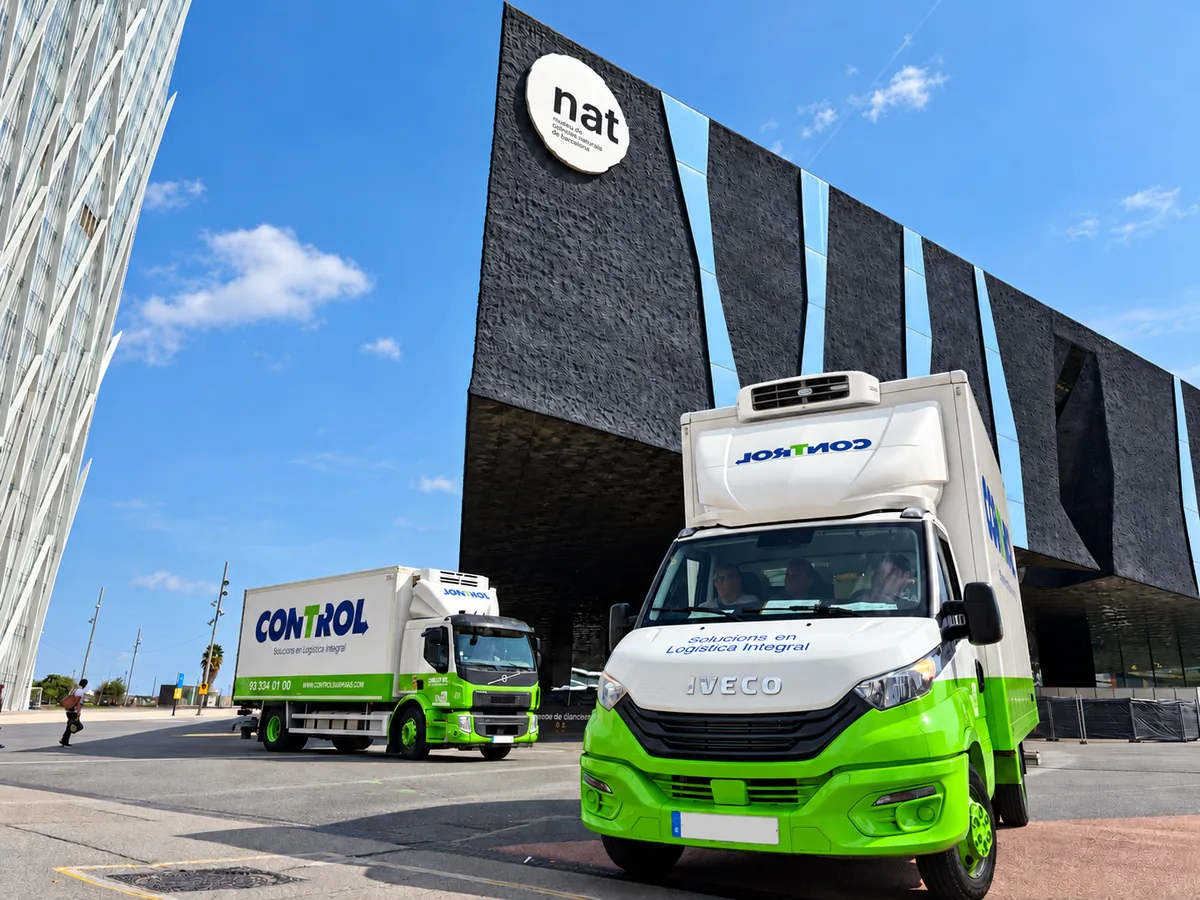
The contract asked for a team with a project lead, supervision and four technical staff, and daily coordination with the Museu and with the General Directorate of Cultural Heritage. We did it with Control’s own staff, with no subcontracting, and at the busiest times we added a short-term reinforcement so we could finish within such a tight deadline.
Inventory, checking and packing of each specimen
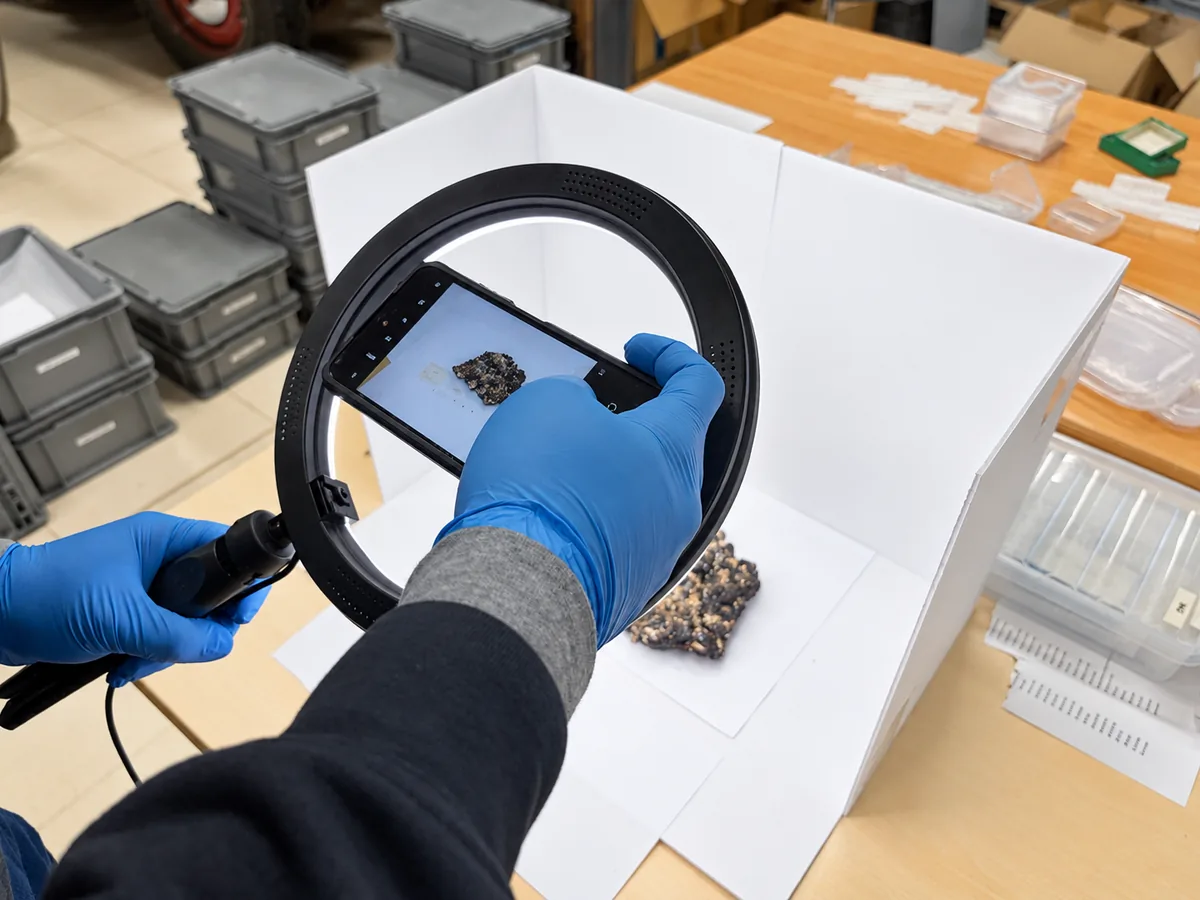
Before moving anything, we needed to know what was being moved. The team made an inventory to identify each mineral properly, checked its condition and photographed it before packing it. The data was recorded at origin and at destination, with double checking. Between inventorying, checking and careful packing, this phase took the most working days.
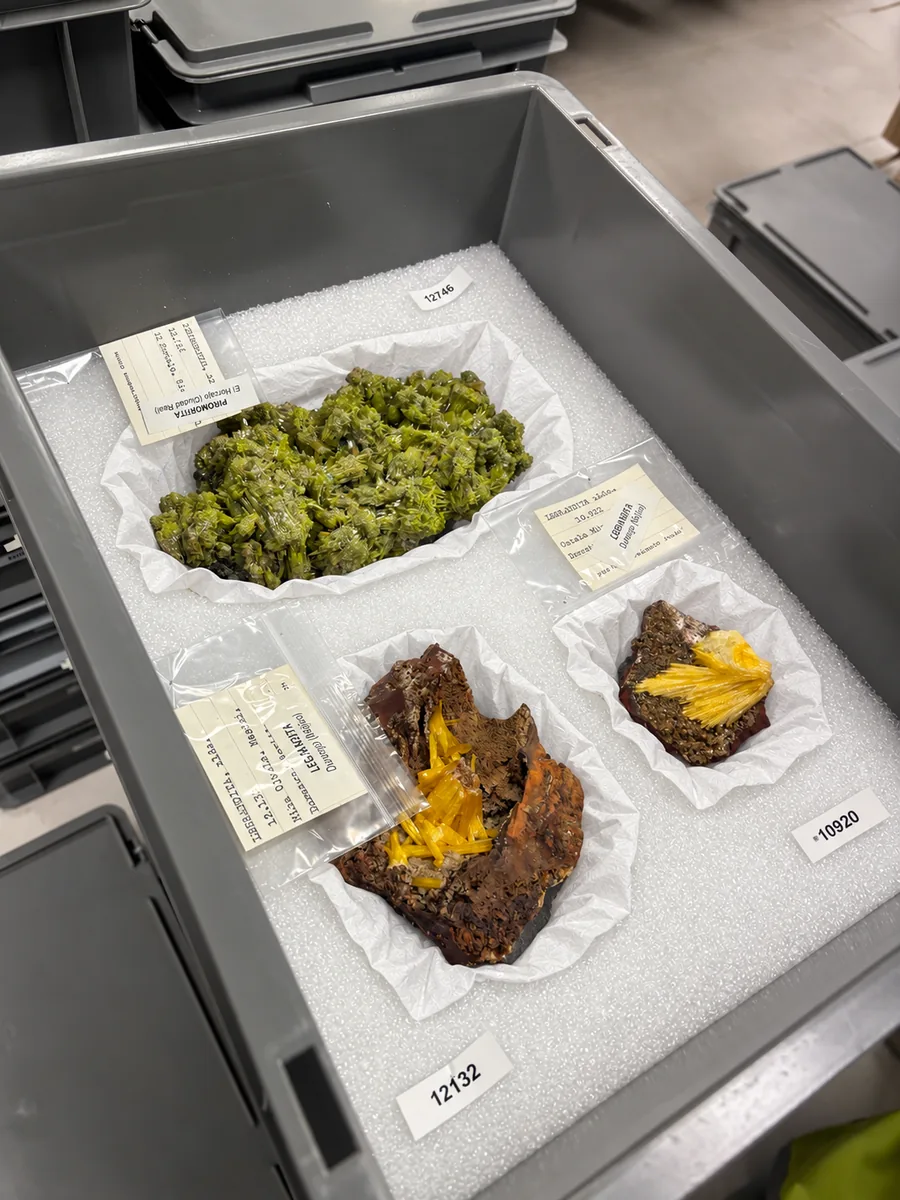
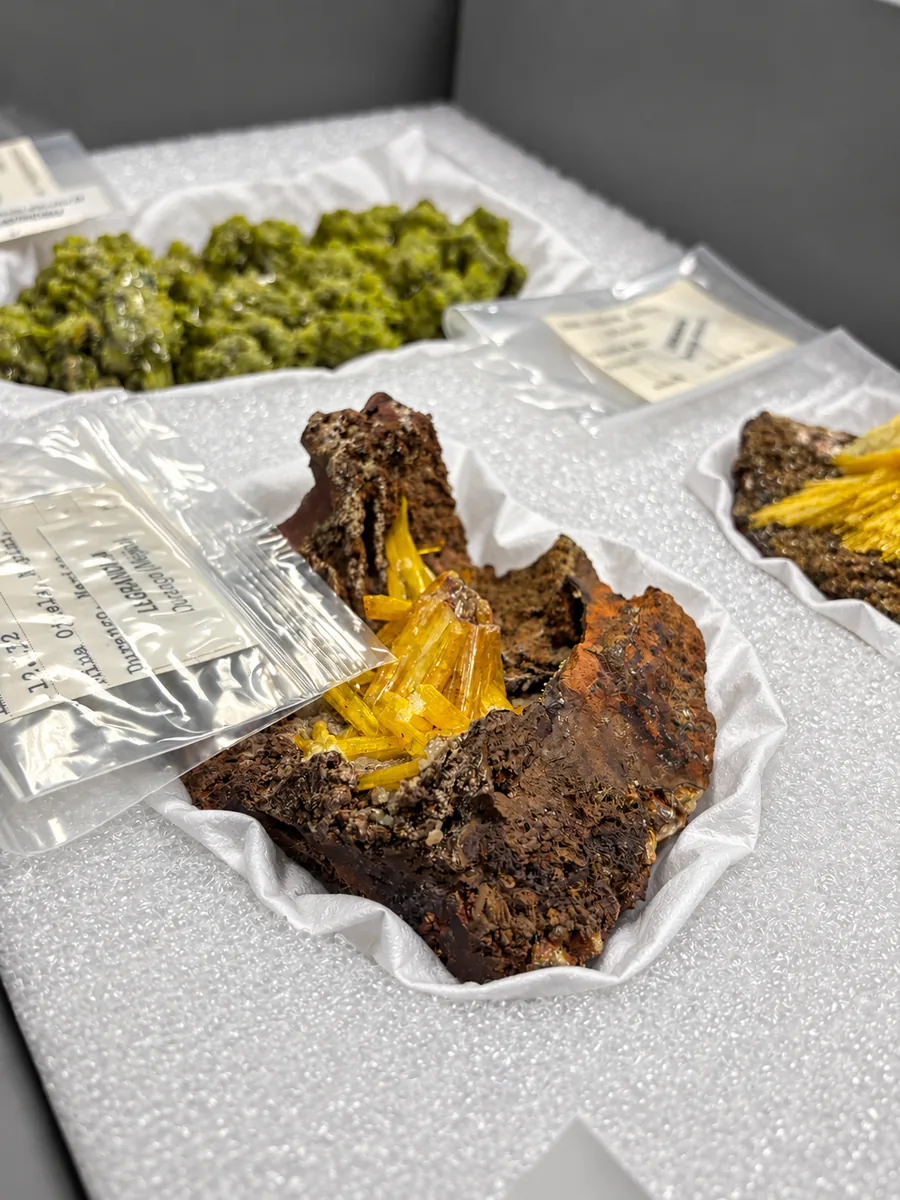
Each mineral was placed in a polyethylene mineralogy box. When it did not fit because of its size, a foam nest was made and protected with Tyvek or tissue paper. These boxes go inside European-standard plastic crates (Euro containers) of different sizes, and the crates sit on plastic pallets. These are the same crates the Museu will use in the reserve, so the specimens do not need to be moved to different boxes on arrival. We added zip bags, manila paper, polyethylene foam sheets, double-wall cardboard and labels, which are the materials the contract required.
Each box carries its own label, and each mineral keeps its original label, in a clear bag beside it. If the label is separated from the specimen, part of the collection’s information is lost.
Minerals that react to humidity
Some minerals do not cope well with humidity. Sulfides, such as pyrite and marcasite, react with the oxygen and water in the air, expand and can end up fragmenting, which mineralogists call pyrite disease. The contract conditions already listed sulfides and sulfosalts among the sensitive species, and between the two groups the collection officially contains about 1,450 specimens, according to the decision that declared it a Cultural Asset of National Interest. The collection includes pyrite and marcasite.
So, in the boxes of some specimens we put Tyvek bags with desiccant to control excess humidity, and throughout the process we monitored the variables that could alter the minerals.
Radioactive minerals
Some of the minerals in the collection are radioactive. The Museu already had a protocol for handling them, and we started from it and improved it. We do not give the details, but here is what we did in each phase.
During packing we made a custom lead plate and placed it in front of the display case where the radioactive specimens were. This way the rest of the minerals were packed with a safe barrier in between. When it was time to pack the radioactive ones, the team worked in shifts to reduce exposure, with suitable protective equipment, lead clothing included, and constant measurement of exposure with a dosimeter that logs data.
For transport we reused the lead barrier, placed it in a U shape and added one more plate, so the protection covers all four directions.
Equipped vehicles
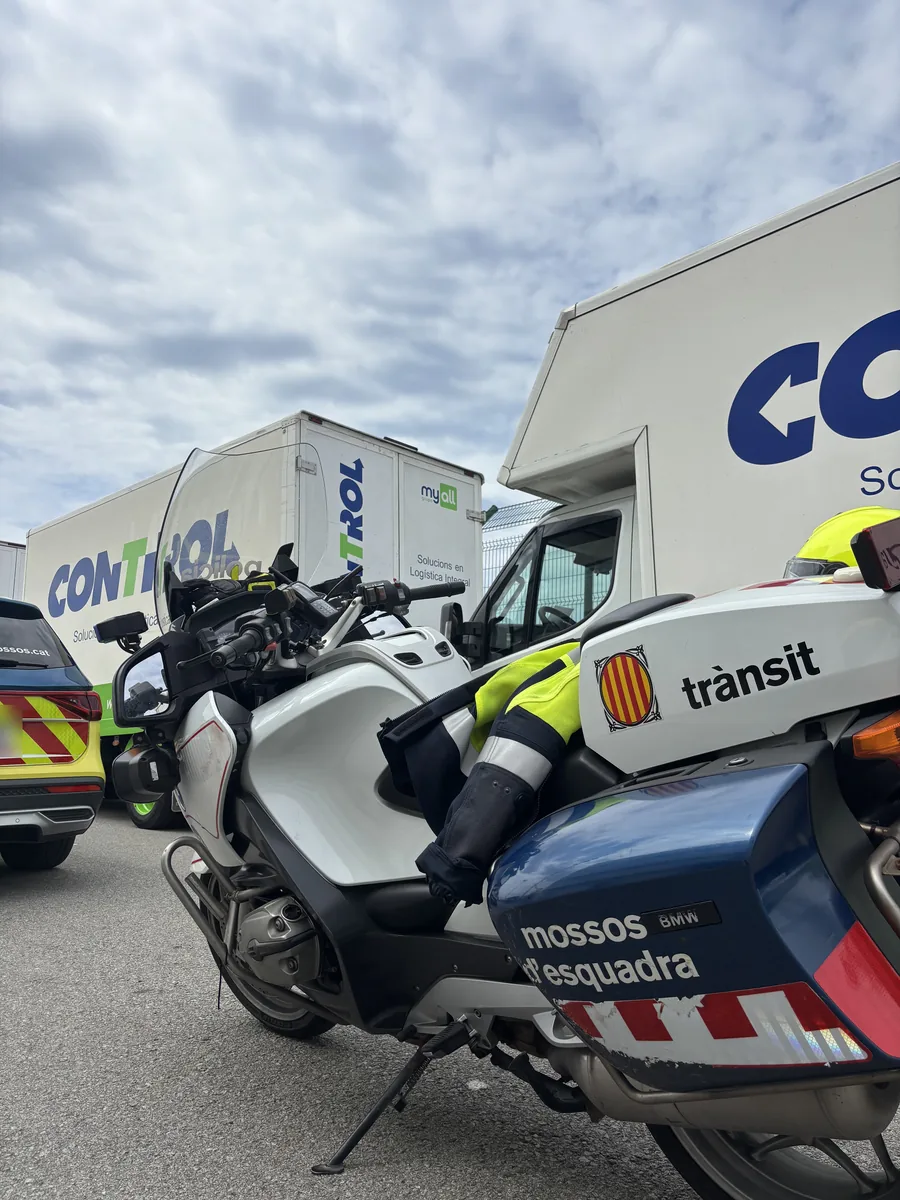
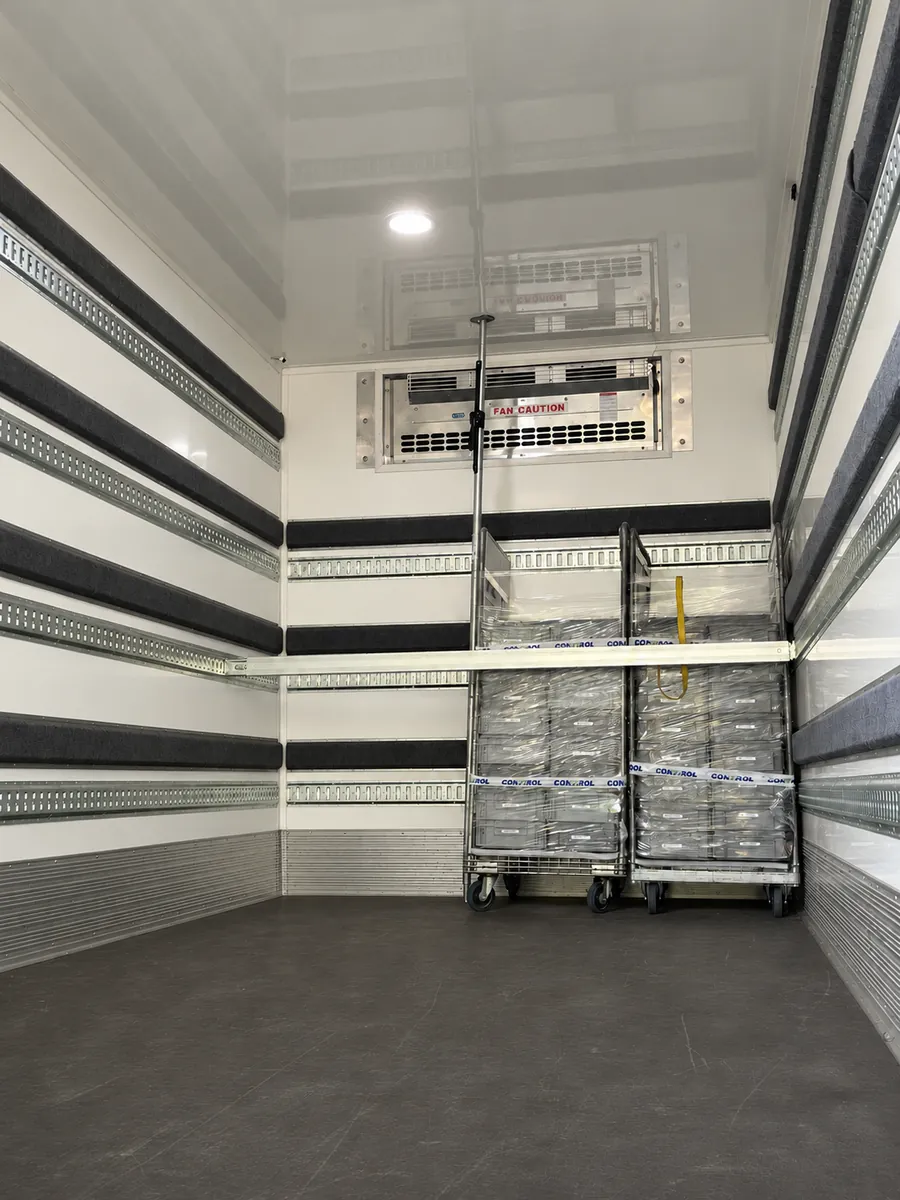
The boxes travelled in trucks with a closed, insulated body, climate control, air suspension that dampens vibration and a tail lift. Part of the collection was also moved under police escort.
Inside the truck, the Euro containers and pallets were placed on trolleys, firmly secured and wrapped in film. At the reserve, the team unloaded, took the pallets apart and put the crates in place.
What comes next
The collection is now in the Museu’s reserve. The book about it, with a selection of about 150 specimens illustrated with photographs, will go on sale in the Museu’s shops and also at the Generalitat de Catalunya’s bookshop.
If you have a collection to pack and transfer
If your institution, museum or university has a scientific or heritage collection to move, tell us what it contains, where it is and when you need it done. We visit the site, check the condition of each specimen and design the packing. We are certified to ISO 9001, 14001 and 45001, and the whole team is our own staff, with no subcontracting, and is committed to each project. Request a quote.
Other projects and services
- Transfer of artworks (service): packing and transfer of artworks and cultural property for museums, institutions and collections.
- Transfer of the Museum of the Port of Tarragona (project): a real case of a museum transfer.
- Packing and transfer of pieces from the Josep Cañas Museum (project): a real case of packing museum pieces.