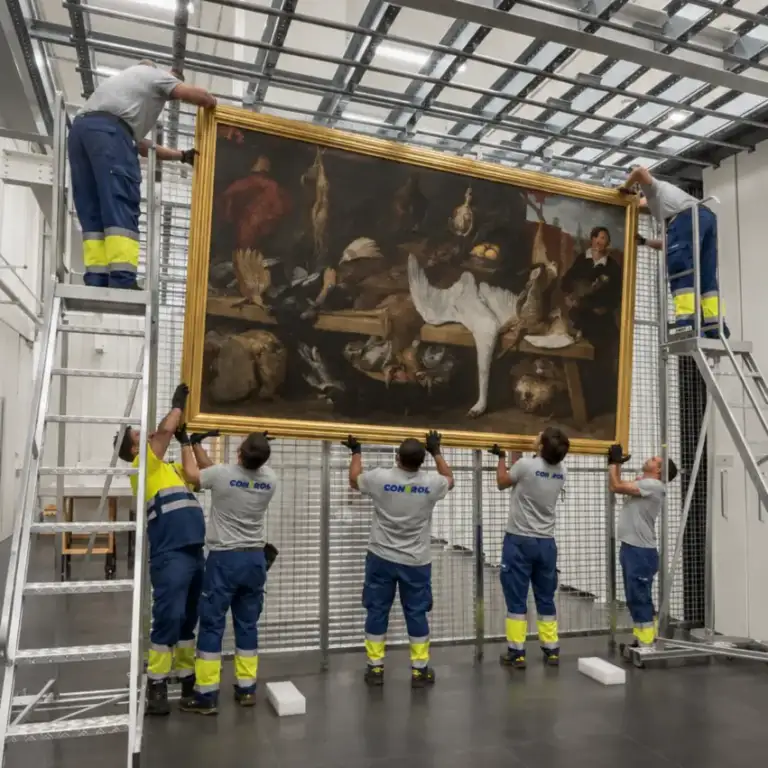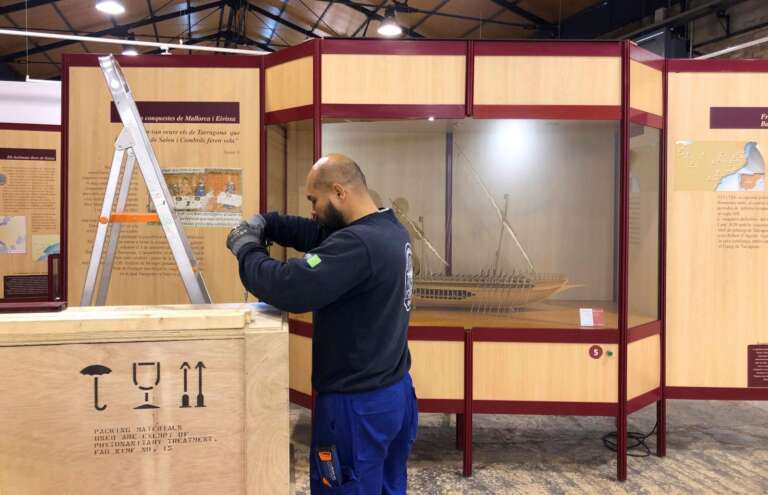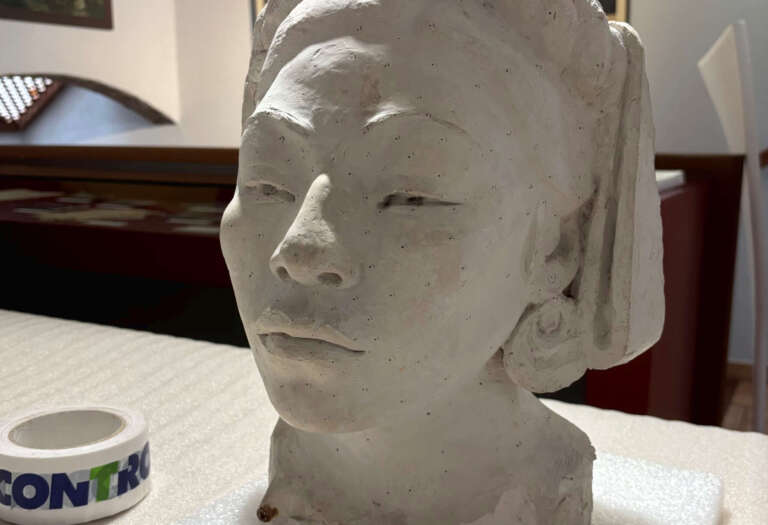
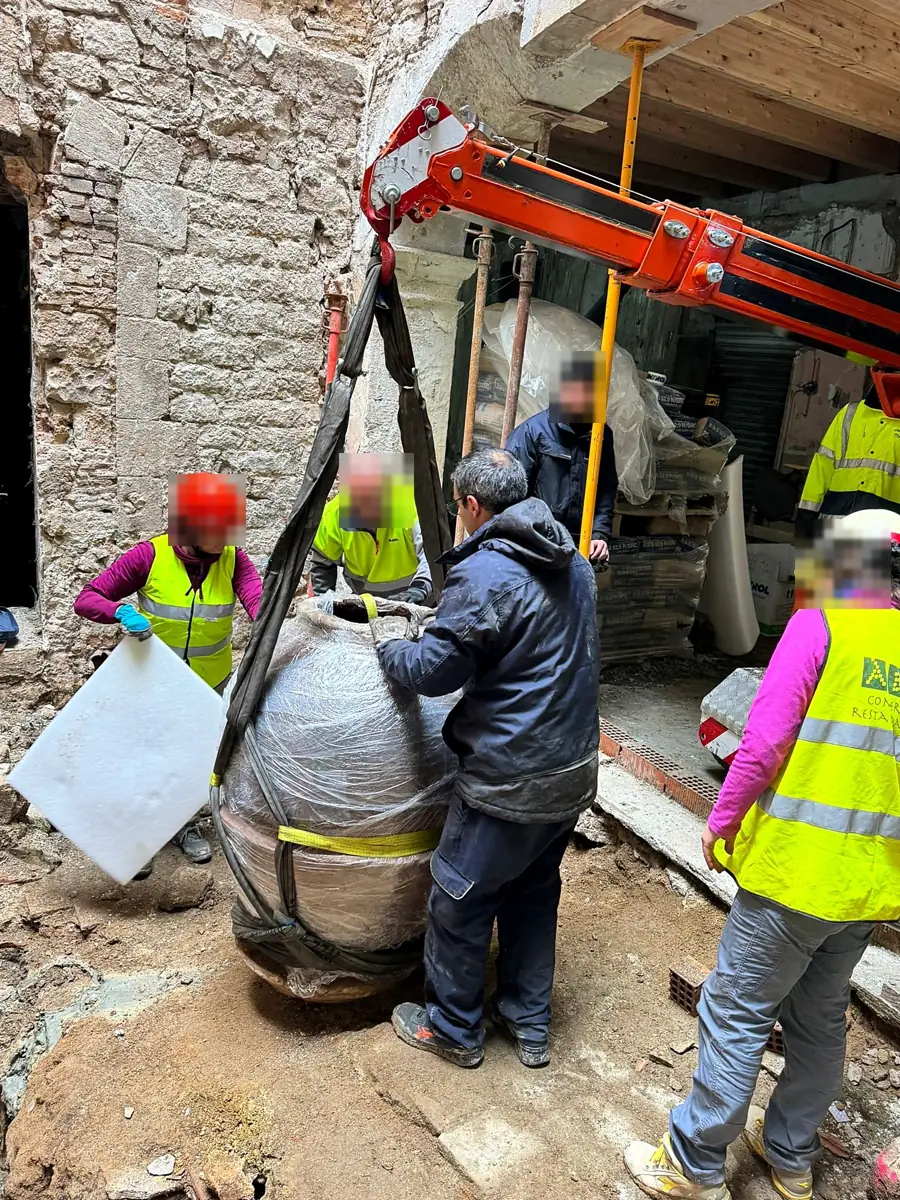
A ceramic jar hangs from the slings of a crane in a courtyard in the Gothic Quarter. Below it is the place it has just come out of. This is the point where the work of the archaeology team passes to the people who have to move the piece without harming it.
We are Control, and we have had the pleasure of working for the Servei d’Arqueologia of Barcelona City Council, which commissioned us to pack and transport excavation pieces from two sites. In this article we explain the jobs we carried out, Plaça de la Llana (April 2024) and Carrer Regomir (February 2026), and how custom archaeological packaging is made: wooden cages that open on every side so the piece can be checked, cleaned or measured without taking it out of its place.
One city under another
Barcelona was Barcino about two thousand years ago, and before and after the Romans other peoples left their mark in the same ground. All it takes is opening a trench to see it. The works on Via Laietana have uncovered Roman and late antique tombs near Plaça d’Antoni Maura, and in 2025 a block of five medieval houses from the 14th century on Carrer de la Fusteria, with remains of the Voltes dels Encants. In March 2026, an excavation on Carrer Antic de Sant Joan, in La Ribera, brought to light medieval streets and bullets from the 1714 siege.
What surprises most about archaeology in Barcelona is how short the distance is. Under streets with shops, residents and traffic there is another city, and every large building project in the old town can open a window onto it. When something turns up, the Servei d’Arqueologia decides what is documented and covered over again, and what is removed for study. What is removed, like the jars from Plaça de la Llana, is deposited at the Centre de Col·leccions de la Zona Franca, part of the Museu d’Història de Barcelona-ICUB. We take the Regomir jars to that same place.
Between the site and the Centre de Col·leccions there is a short, delicate stretch. That is where we work.
Two sites, two transfers
The pieces in these two jobs are tenalles, the Catalan name for large ceramic storage jars, wide in the belly and heavy. In both cases we used similar means (custom-made packaging, handling with a crane and transport by truck), but each job required a detailed review of the equipment, the access routes, the condition of the pieces and how fragile they were, and that meant adapting the procedure to suit each situation.
Plaça de la Llana, April 2024
At number 23 Plaça de la Llana, in Ciutat Vella, a team of women archaeologists gradually uncovered the remains of a 14th-century medieval manor house that later became an inn and, in the 19th century, Clemente Guardia’s chocolate factory. BTV reported it in February 2024 and the Servei d’Arqueologia documents it on its website, with seven jars found at the site. The City Council press release explains that, once documented, the remains are taken to the Centre de Col·leccions de la Zona Franca, and that bioarchaeological analyses will be carried out there to find out what those large vessels had contained.
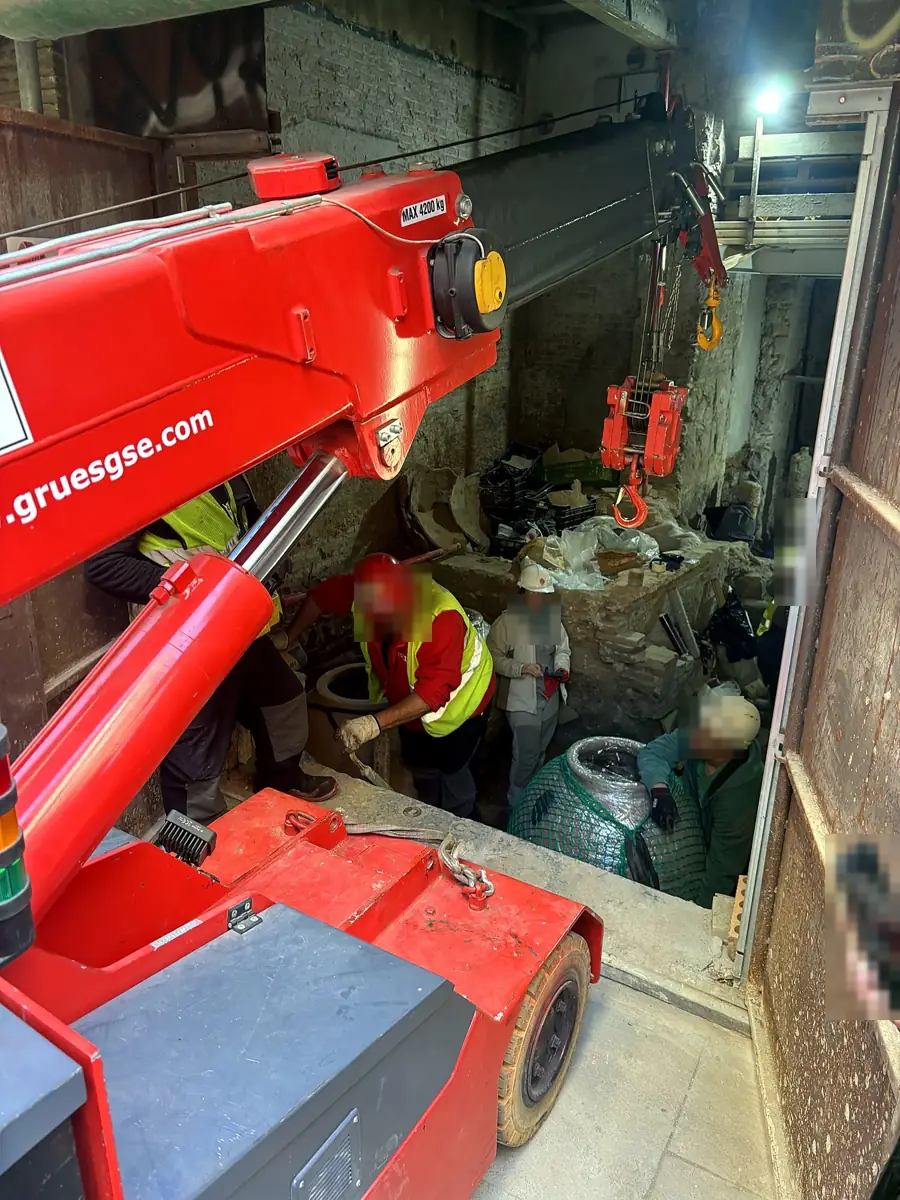
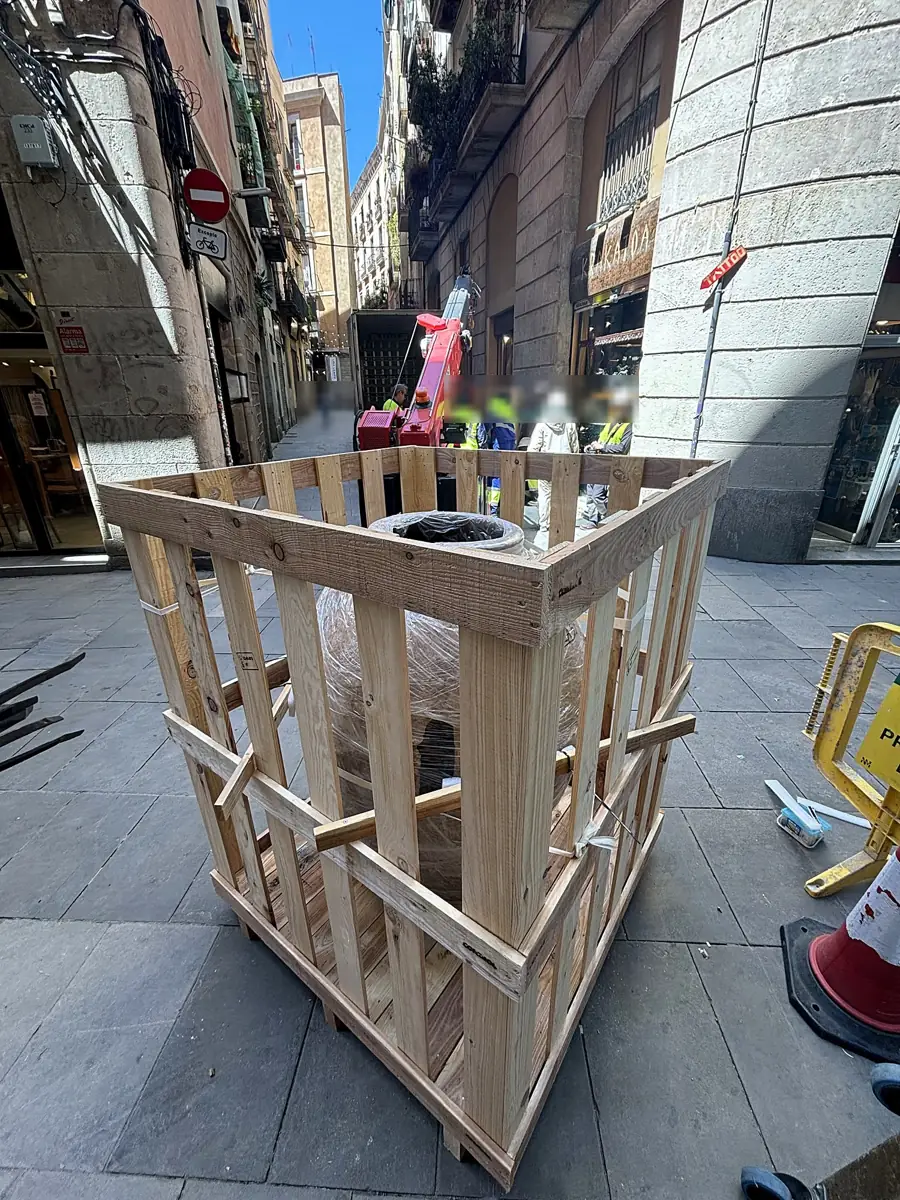
On 24 April 2024 we removed the main pieces, each more than 120 × 85 cm and weighing between 100 and 150 kilos. Other pieces were properly packed alongside them and transported in euro-standard plastic crates and on plastic pallets suited to this type of transport. A red crane worked inside the site. The jars reached the street wrapped in plastic and were placed in wooden cages with the help of the site’s crane company and three people from our team, in a narrow street in Ciutat Vella.
Carrer Regomir, February 2026
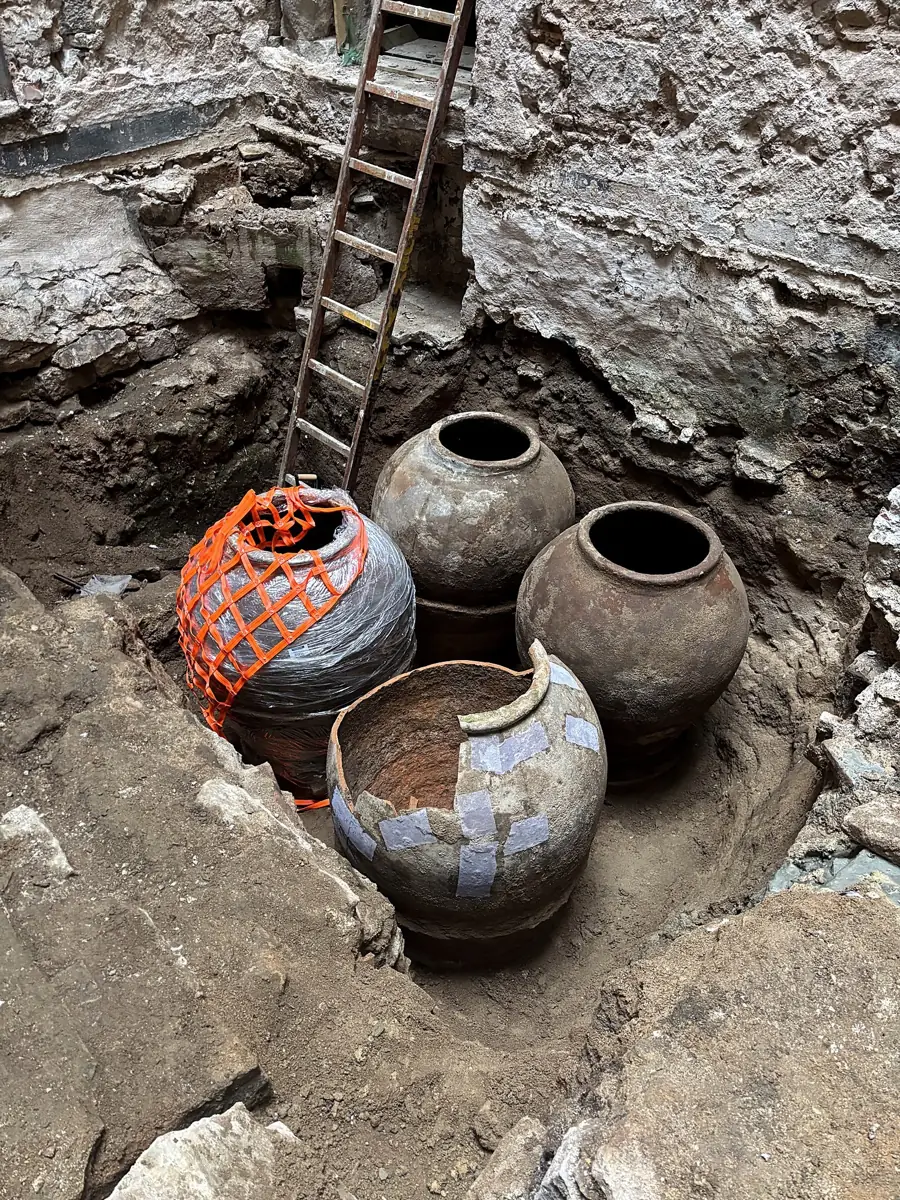
Almost two years later, between 2 and 4 February 2026, we did the same at Carrer Regomir 11, in the heart of the Gothic Quarter. The building has a history: it is the Gualbes palace, from the 14th century, and in 2014 the Servei d’Arqueologia documented there part of the frigidarium pool of a Roman bath complex, built between the mid-1st and early 2nd century and demolished when the late-imperial wall was built, at the end of the 3rd.
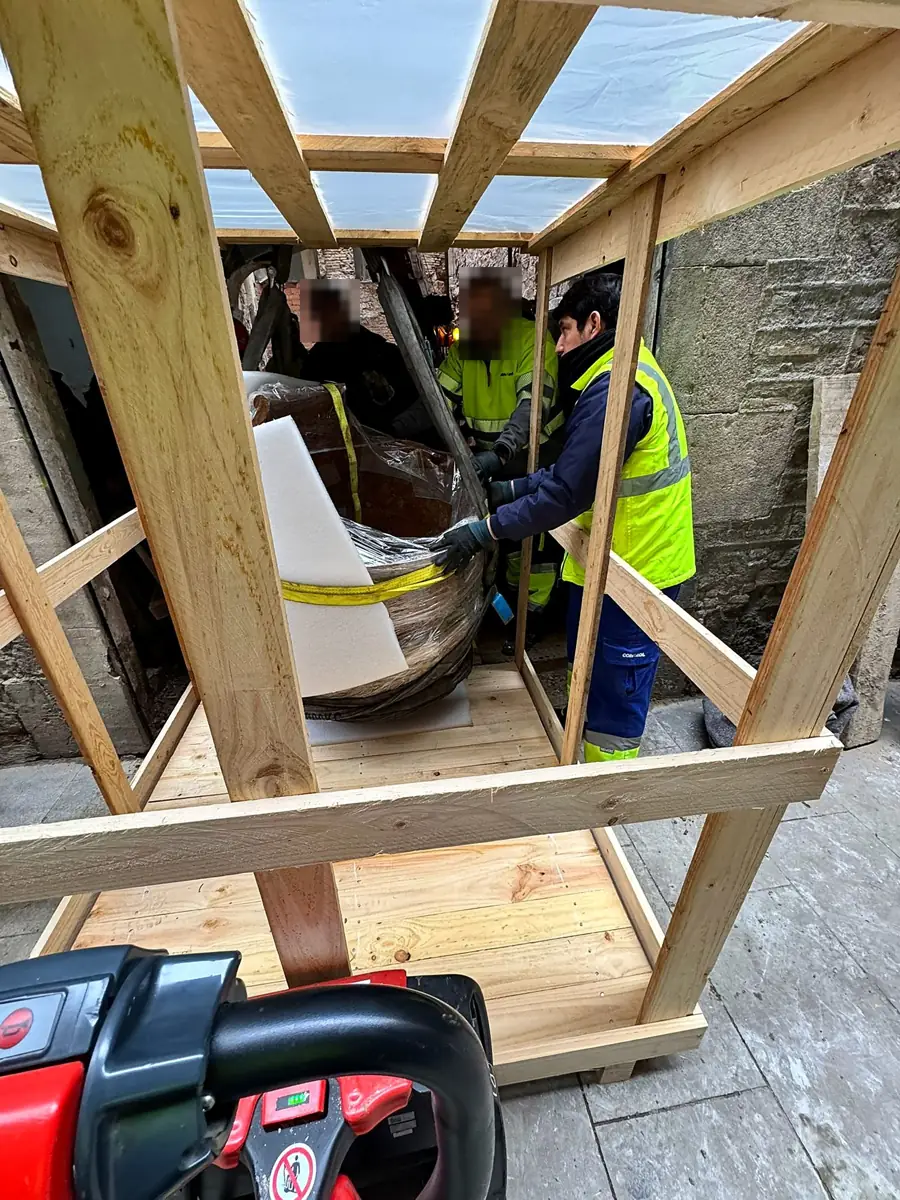
This time the jars were large ones, inside the building. Which period they belong to is for the archaeology team to say. Our work starts when the piece is ready to be moved. The archaeology team left them separated from the floor and empty inside, so we could pass the netting and slings under them before lifting. We took them out with a 3.2-tonne pick&carry crane and brought them to the Centre de Col·leccions de la Zona Franca.
Custom packaging for archaeological pieces
A jar is not packed in an off-the-shelf box. It has a wide belly, a delicate rim and a weight that does not allow poor support. That is why the packaging is made for each piece, to its measurements, taking care that the weakest parts are never a point of support or stress.
Cages that open on every side
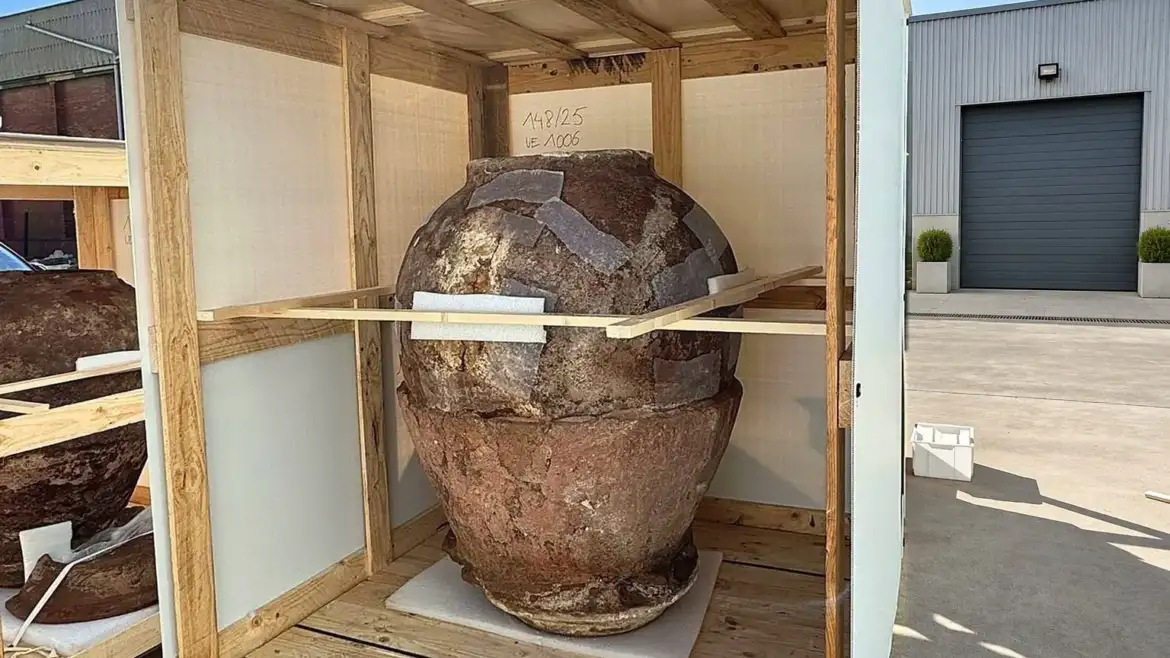
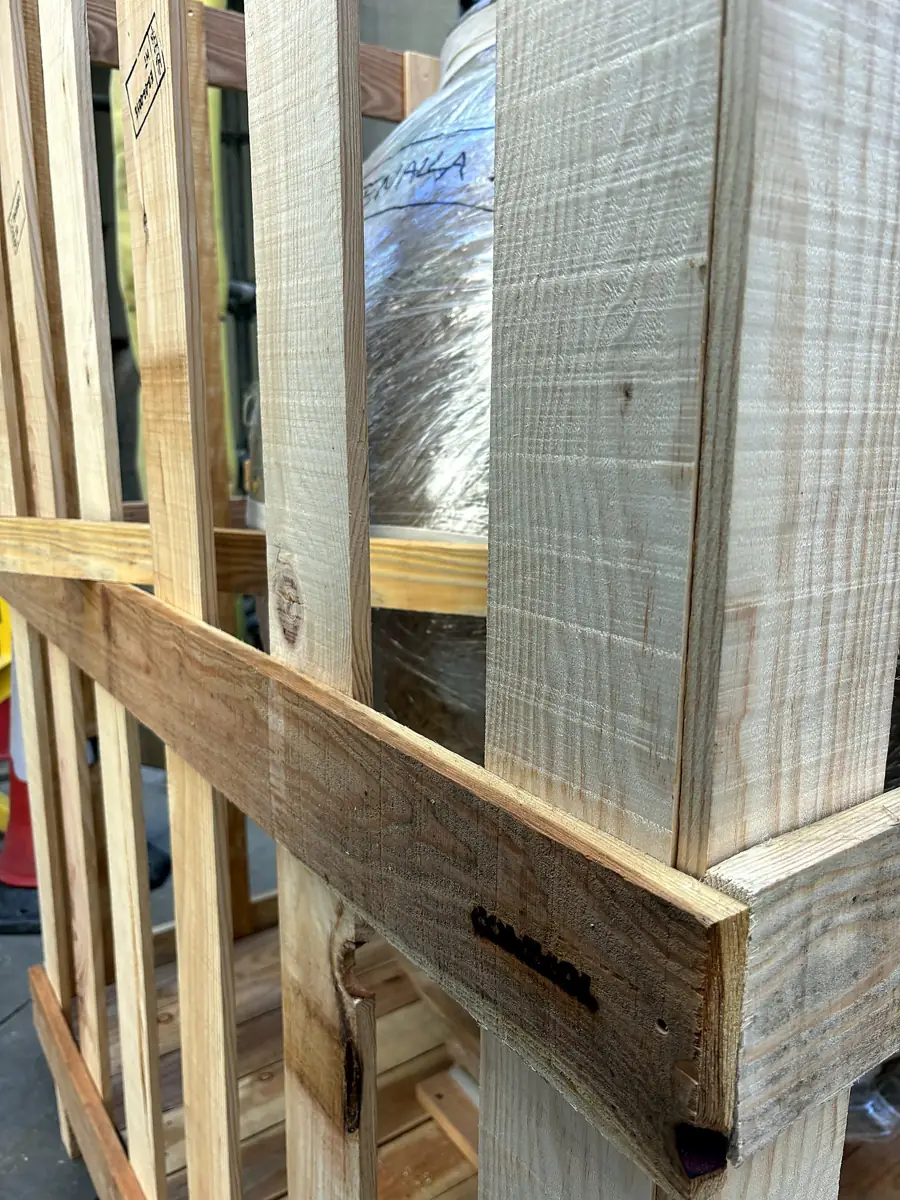
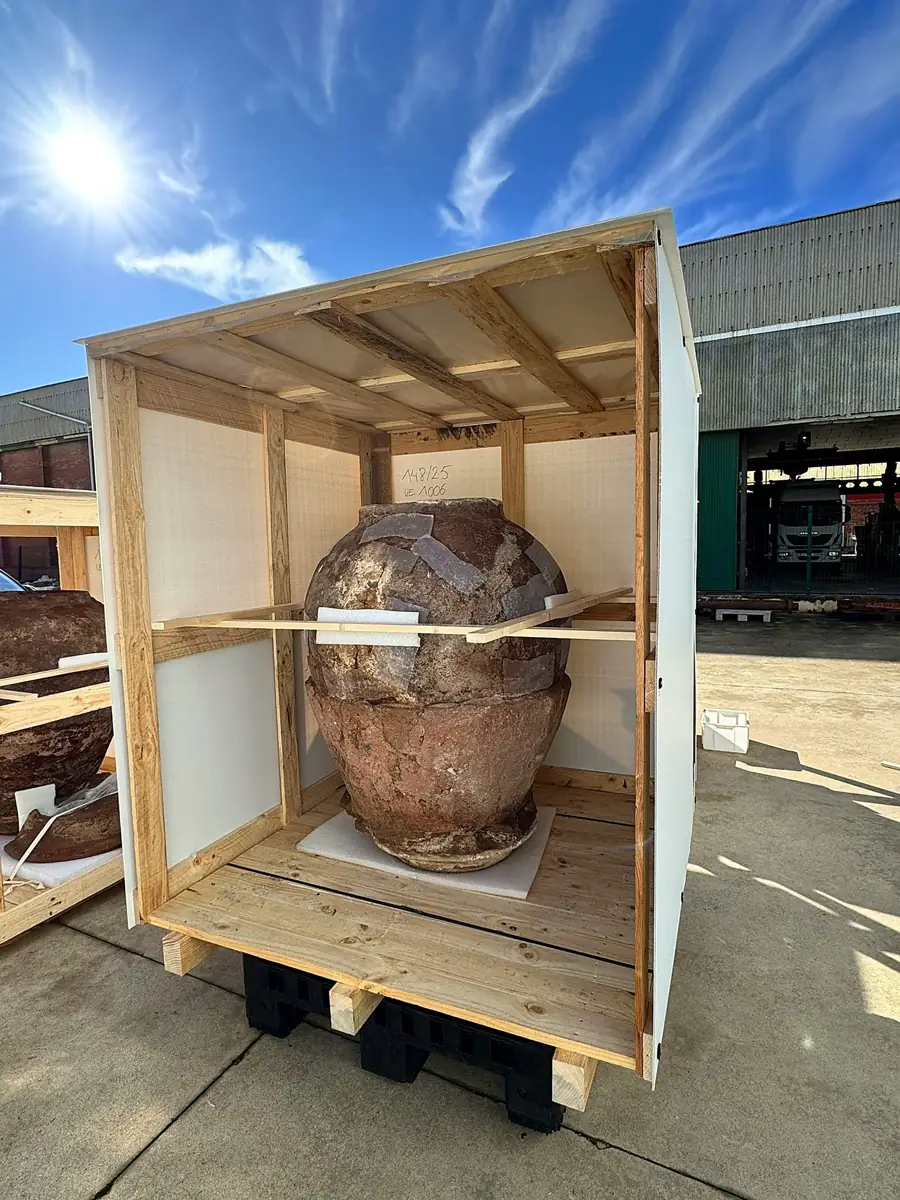
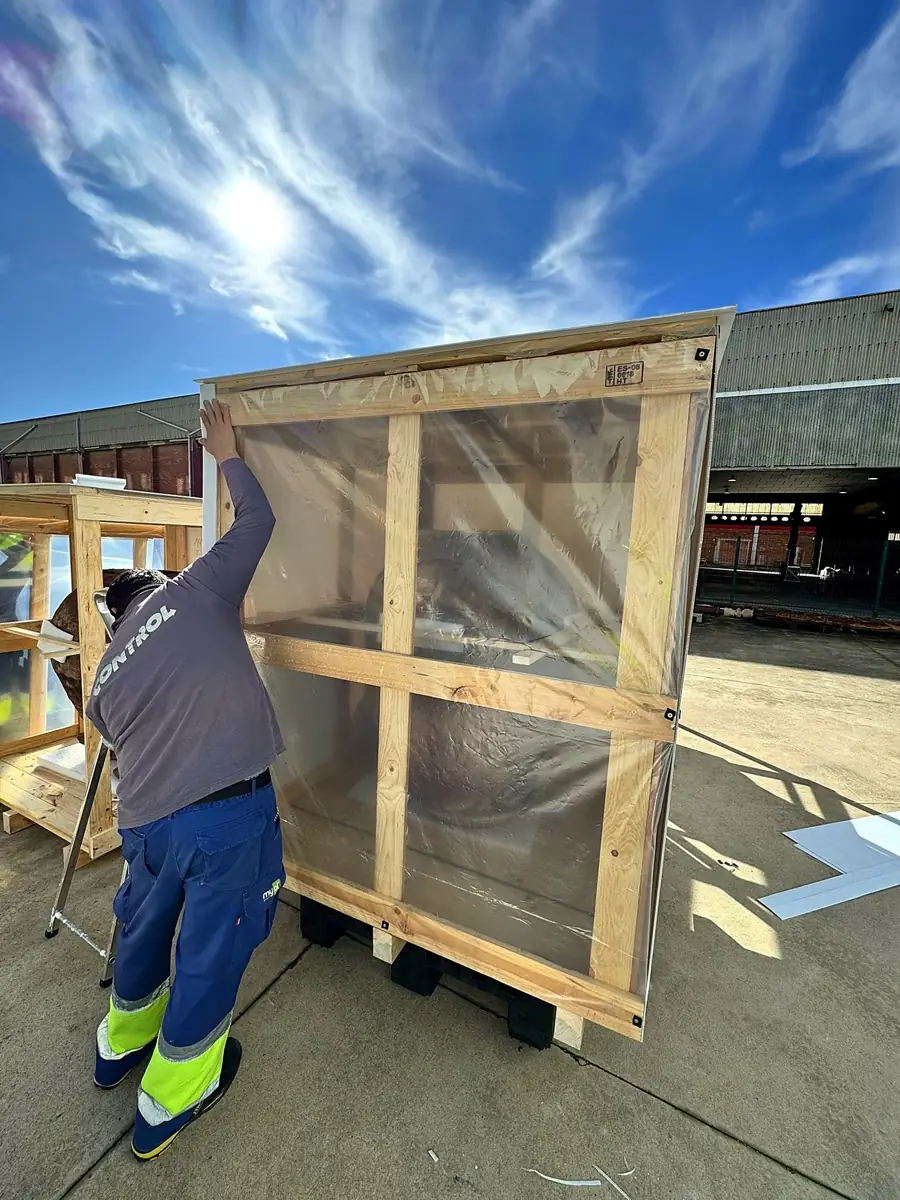
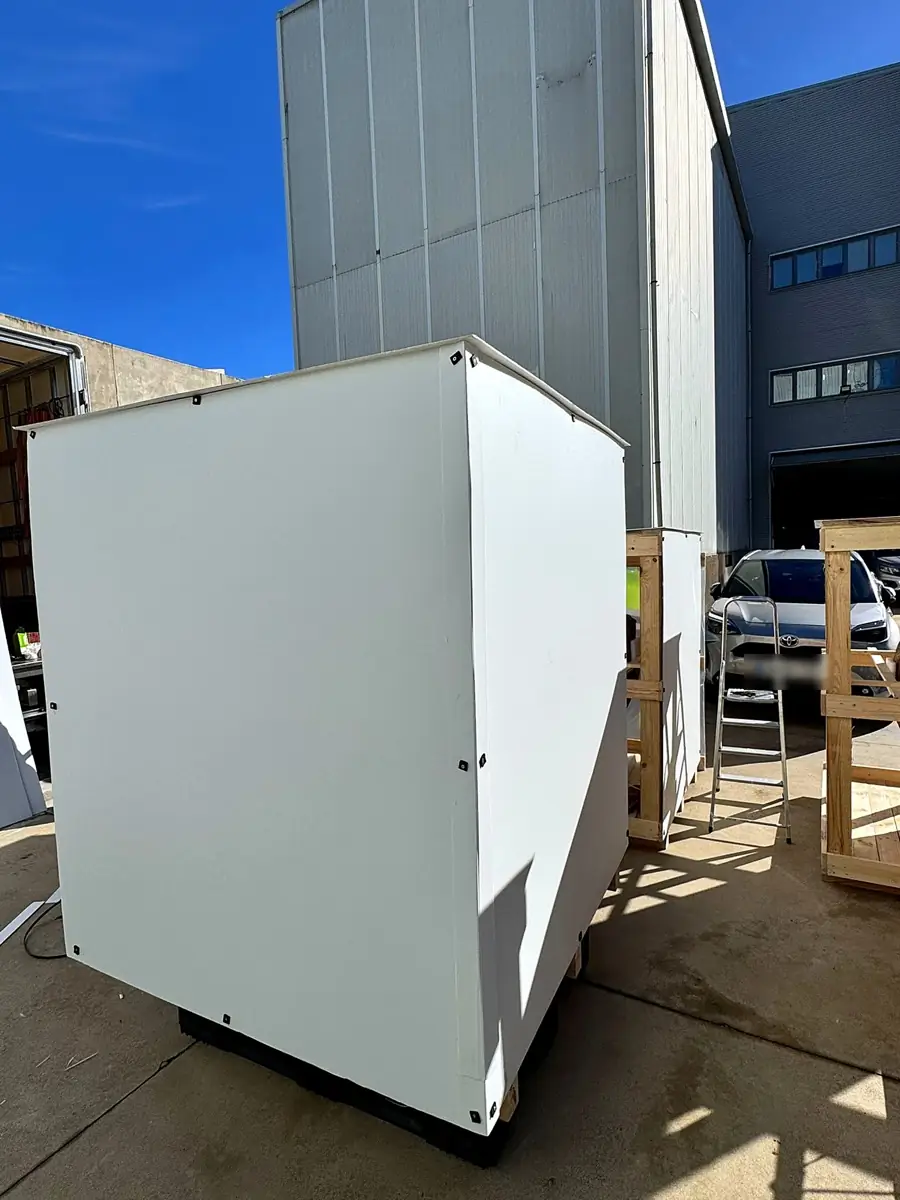
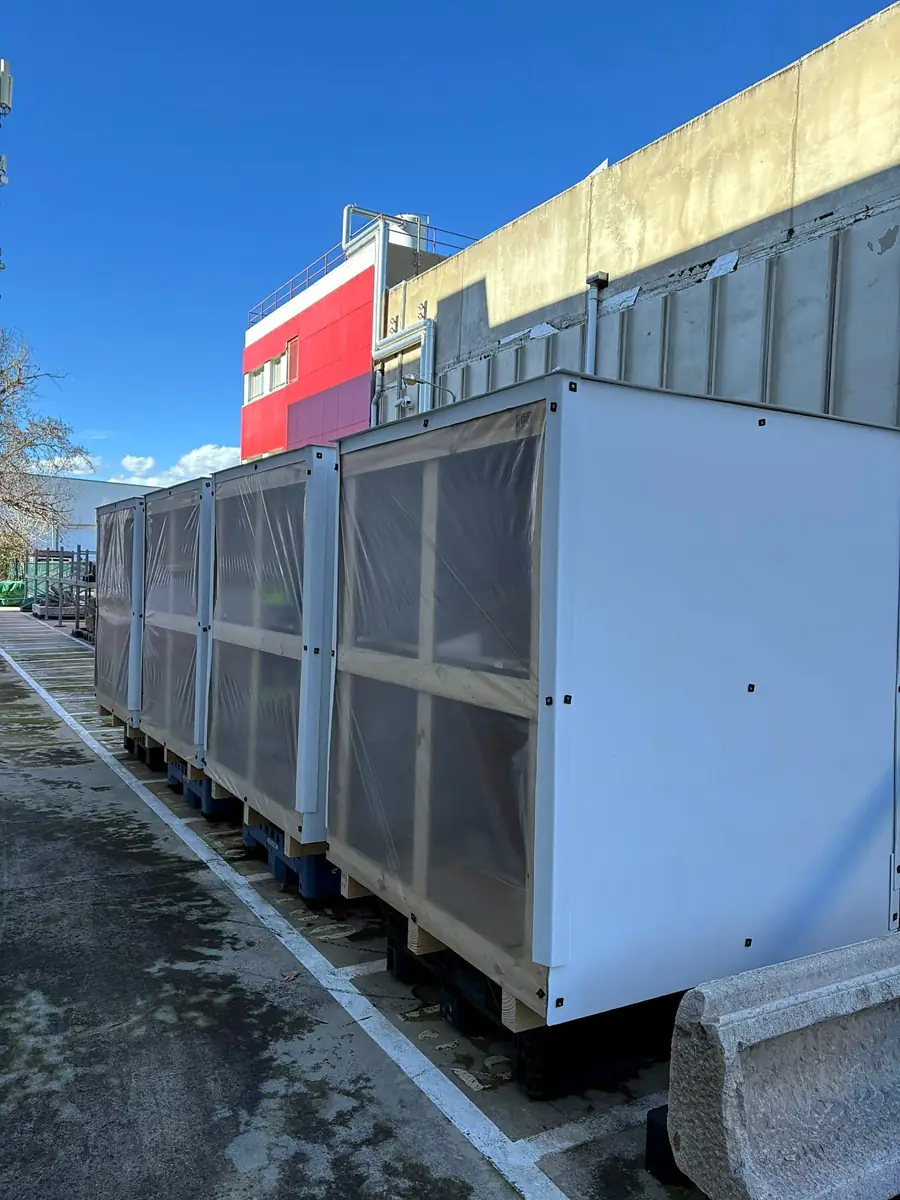
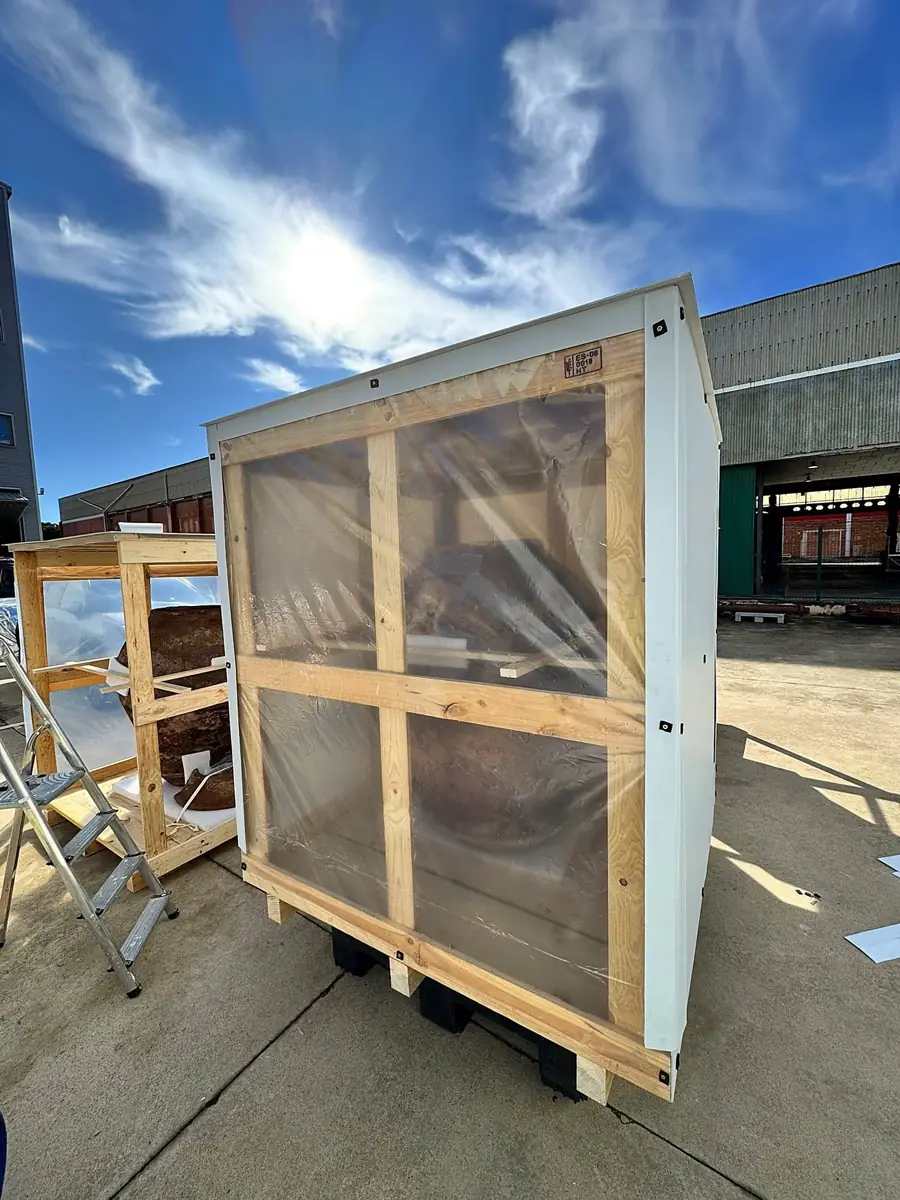
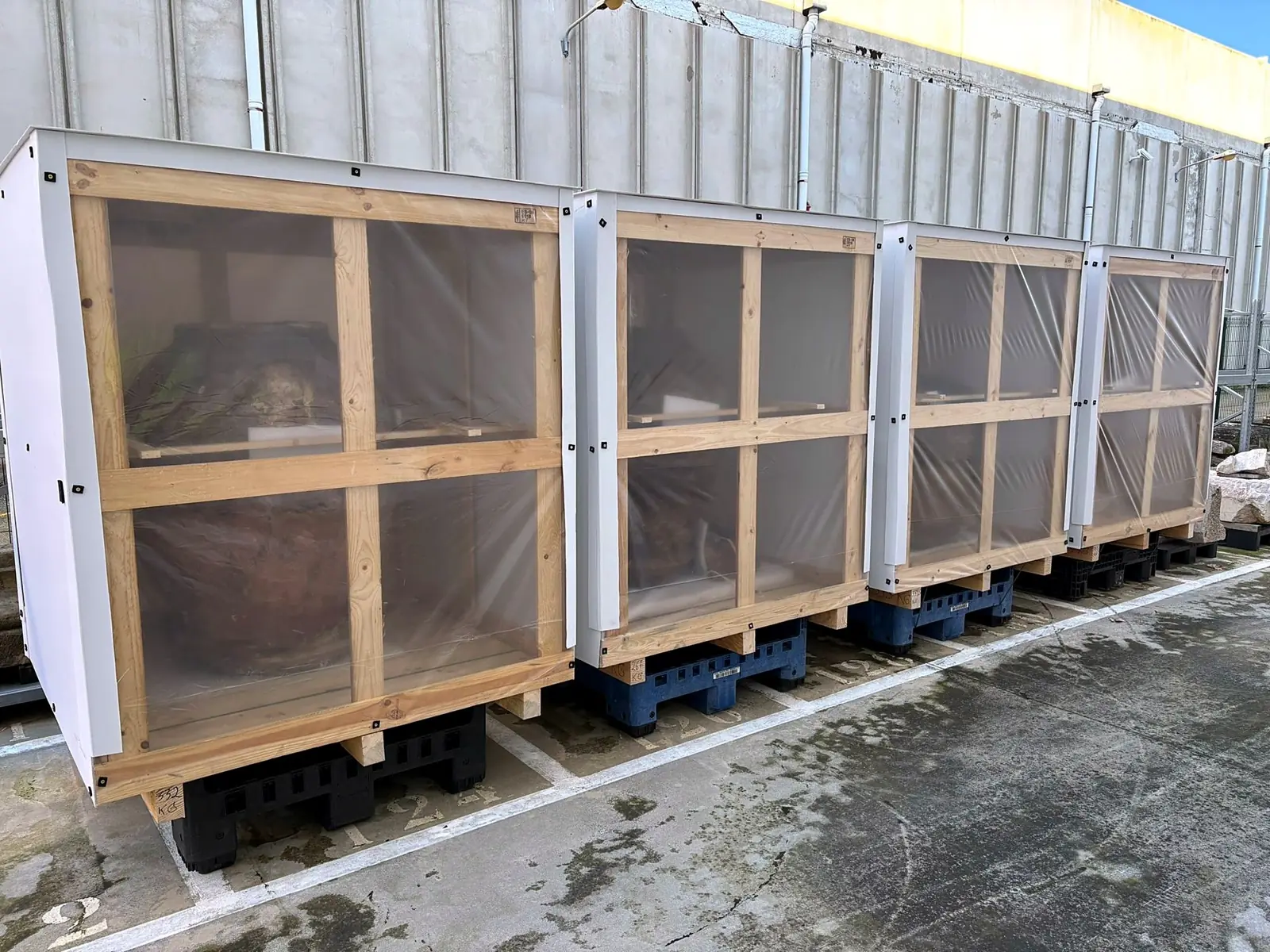
The Regomir cages are made of treated wood and designed to be opened again. They have top, front, rear and side panels, and all of them can be removed for inspection: they come off so the piece can be checked, cleaned or measured directly, without taking it out of its place. The panels are made of cellular polyethylene and polypropylene, and the front is closed with a transparent film that lets you see the jar from outside.
An archaeological piece can spend years in storage, and for all that time it has to be possible to look at it: to check that no cracks or efflorescence appear, note its condition, measure it, photograph it. Packaging that is sealed shut has to be undone every time. An inspectable cage can be opened on whichever side is needed and closed again.
Plastic pallets and ventilation
Each cage is assembled on a plastic pallet that fits the cage’s joints exactly, so the two parts of the packaging are fully compact. The pallet isolates the wood from the floor and cuts off rising damp, the moisture that climbs through porous materials from a wet floor. The underside of the cage is ventilated so that air circulates and does not stagnate around the ceramic. A piece that has spent centuries buried has reached a balance with its surroundings, and changing its environment has to be done without sudden shocks.
Inside the cage
The jar rests on foam. Wooden slats, cut to size and adapted on site to get a perfect fit, hold it at shoulder height, and a natural-fibre rope completes the fixing. No jar is ever lifted by its rim. The weight is spread with netting and wide slings, the piece travels upright and we never stick tape on the ceramic.
Packing and transporting is part of preventive conservation: what we aim for is that the piece reaches the Centre de Col·leccions just as it left. Cleaning, consolidating or restoring it is the work of the conservation-restoration team. Ours begins when the piece is ready to be moved and ends when it is installed in its cage.
Transport in a vehicle with full air suspension
The cages travel in a truck fitted with full air suspension and a tail lift. The air suspension dampens vibration on the journey, one of the things we look after most with ancient ceramics. At Regomir we unloaded at the dock of the Centre de Col·leccions de la Zona Franca and left the cages lined up in a row.
We deal with the parking permits ourselves, and the transport comes with insurance and public liability included. We ask for between 10 and 20 days’ notice to organise the crane, the truck and the permits.
If you have pieces to pack and transport
If your institution, museum or excavation team has archaeological pieces, ceramics or cultural property to move, tell us what there is, where it is and when you need it. We visit the site, measure the pieces and make the packaging. We are certified to ISO 9001, 14001 and 45001, and the staff who pack and load are our own, with no subcontracting. Request a quote.